Supreme Court to Hear Oral Arguments on Same-Sex Marriage Today

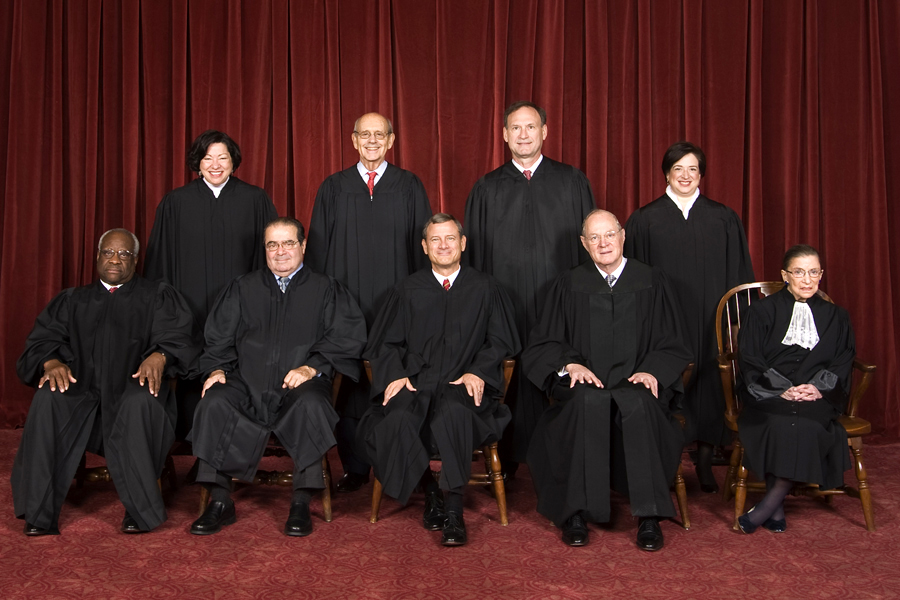
Supreme_Court_US_2010The Supreme Court will hear oral arguments for Obergefell v. Hodges regarding the constitutionality of same-sex marriage this morning. The Court will consider two primary questions:

  1. Does the Fourteenth Amendment require a state to license a marriage between two people of the same sex?
  2. Does the Fourteenth Amendment require a state to recognize a marriage between two people of the same sex when their marriage was lawfully licensed and performed out-of-state?

The answers to these questions will decide the future of marriage across the United States. If the answer to the first question is “Yes,” then same-sex marriage will be legalized nationwide, and the second question would be irrelevant. If the answer to the first question is “No,” but the second question is answered “Yes,” then it will authorize de facto same-sex marriage across the country. If both questions are answered “No,” then the status quo will continue.

You can follow a live blog of the oral arguments from SCOTUSblog at http://live.scotusblog.com/Event/Live_blog_Obergefell_v_Hodges. The live blog launches at 9:45 a.m. (CDT).

This case has the potential to be a defining Supreme Court decision for this generation. It could possibly change the definition of marriage for generations in our country. It has the potential to undermine the most fundamental institution in society, and I do not believe that to be an overstatement.

I encourage you to join with the Ethics & Religious Liberty Commission and others as we pray for marriage. A sample prayer guide can be found at http://erlc.com/article/prayformarriage. We should also pray for the Supreme Court justices by name as the hear the arguments today. They are John Roberts (Chief Justice), Antonin Scalia, Anthony Kennedy, Clarence Thomas, Ruth Bader Ginsburg, Stephen Breyer, Samuel Alito, Sonia Sotomayor, and Elena Kagan. Let us heed the words of Paul to his son in the faith, Timothy, as he wrote:

First of all, then, I urge that entreaties and prayers, petitions and thanksgivings, be made on behalf of all men, for kings and all who are in authority, so that we may lead a tranquil and quiet life in all godliness and dignity. (1 Tim 2:1-2)

New Essay in Journal for Biblical Manhood and Womanhood

The editors for the Journal for Biblical Manhood and Womanhood were kind enough to publish an essay of mine in the latest issue of the journal. The main focus of this issue is sexual identity; however, there are some articles and essay that address other topics as well.

My essay is entitled “The Not-So-Unified Narrative of the LGBT Movement.” Here is an excerpt:

Many Americans see the LGBT (Lesbian, Gay, Bisexual, Transgender) movement as a unified whole marching toward an end-goal of equality, acceptance, and significance within society.1 The four letters used to describe the coalition flow off the tongues and through the keyboards of activists and dissenters alike. However, not everything  is as unified as some may portray. Is the narrative of the LGBT movement really a unified whole, or are there underlying differences between factions in the group? Is there a unified political goal to be achieved that hides a schism below the surface? Such questions are beginning to be asked, and Christians contending for truth need to be aware of fissures within the LGBT movement.

What rests beneath the surface is a conflict of narratives between the LG’s (Lesbians and Gays) and the BT’s (Bisexuals and Transgenders).

Because the divisions between LG’s and BT’s are clearest on the issues of gender and marriage, this essay will sketch out the typical, public LGBT narrative on gender and marriage and then demonstrate how bisexuals and transgendered people undermine the public agenda of the LGBT movement. In doing so, we will see that this coalition of convenience may rupture unless one of the two groups is willing to shift its narrative to appease the other.

My essay concludes by stating:

Even though the focus of this essay has been to expose the fissures in the LGBT movement, I want to end with a call back to biblical sexuality. Genesis 1–2 gives us a clear picture of God’s design for sexuality from the beginning. In Genesis 1:27 we read, “God created man in his own image, in the image of God he created him; male and female, he created them.” From the outset, God created two genders—male and female. Every example of godly sexual expression we see from that point forward in Scripture comes through the union of a man and woman in marriage. Genesis 2:24 tells us, “For this reason a man shall leave his father and his mother, and be joined to his wife; and they shall become one flesh.” When Jesus discusses marriage and sexuality in Matthew 19 and Mark 10, he appeals to these two foundational verses in Genesis. When Paul talks about marriage in Ephesians 5, he also appeals to the complementary nature of man and woman and points back to Genesis 2:24 as the key text.

Monogamous,  heterosexual marriage is commended, and even celebrated,  as the biblical expression of sexuality. All departures from this standard are considered acquiescence to the sinful, fallen nature of mankind. Thus, we do not point out the conflict in the LGBT movement as an end in itself, but we do so for the purpose of calling everyone caught up in sexual sin back to God’s plan for sexual- ity. We should be reminded of the words of Paul in 1 Corinthians 6:11 after he pointed out a number of sins—including some of a sexual nature—in the church at Corinth: “Such were some of you; but you were washed, but you were sanctified, but you were justified in the name of the Lord Jesus Christ and in the Spirit of our God.”

If you would like to read the entire essay, you can find it here. A PDF copy is also available here.

Taking the Roof Off: The Apologetics of Francis Schaeffer

*The following is an excerpt from my article published by the Ethics & Religious Liberty Commission. I was asked to reflect on an author who had changed the way I think.

My parents had a hardback version of Francis Scaheffer’s How Should We Then Live? sitting on a shelf in our house. It was a large, beautiful book, but I never took the time to read it. Honestly, the title never made sense to me as a child, and I had little interest in reading anything that I thought could be difficult to understand.

Years later I enrolled in a Ph.D. program and once again encountered Schaeffer’s work. An entire seminar focused on the ethics of Schaeffer, and I had the task of reading virtually everything that Schaeffer had published. That seminar changed my life and the way I think.

One key element of Schaeffer’s work that I found especially influential was his apologetic method of “taking the roof off.” Schaeffer argued that a person’s worldview is similar to a house; however, there is only one blueprint that can effectively explain all aspects of life and be lived out consistently—a Christian worldview. All other worldviews are defective in one way or another.

The rest of my article can be found at the ERLC website.

Facilities Policies: Changing Your Church’s Constitution and By-Laws

wedding ringsThis is the fourth installment of a multi-part series addressing why churches need to consider updating their organizational documents. The series is written in conjunction with Waylan Owens. This post is Part 4 and was written by Dr. Owens, originally appearing here. For the first three parts are “There’s No Time Like the Present,” “We Believe…,” and “Wedding Policies.”

Many years ago, I (Waylan) attended my first wedding in a Roman Catholic church. Though not my first visit to a Catholic church, the wedding has lasted in my memory and still forms one of the bases of my experiential understanding of Catholicism.

When I pass by church buildings, I look for a sign. Then I think to myself, “That is a Baptist church” (or a Methodist church or a Catholic church, according to the message on the sign). Now I know that no denomination believes that its buildings are the church. Yet when I see a building or walk inside, I still think to myself, “So this is ‘Such and Such’ Church.”

And I attribute to that church whatever I see happening in and around the buildings. If I know that the Boy Scouts meet in the church buildings, I assume the church endorses the Boy Scouts. If I see the buildings used for the feeding of the homeless, I assume the church is benevolent, even though none of the members might participate in the ministry. If I see a wedding involving a couple of two men or two women, I do not think, “Oh, someone must have borrowed the building.” I think, “This church must approve of homosexual marriage.”

I am not unusual in this regard. This is a normal way of thinking for people, and for most non-members, the buildings of a church are the most consistent witness of the church. Because of this, it is vital for churches both to have policies for the use of its facilities and to be intentional in keeping them.

The Alliance Defending Freedom observes, “Put simply, a church has a right to only allow uses of its facilities that are consistent with its religious beliefs and to deny all other uses.” Notice that the key is that the facilities are used in ways that are consistent with religious beliefs only. ADF continues, “The best way to protect your church is to adopt a facility usage policy that outlines the religious nature of the church buildings and restricts usage of the facility to uses that are consistent with the church’s biblical beliefs.”[1]

To protect their witness and to simplify things, some churches have held to a policy that only church members may use church facilities. However, what happens when a church member, perhaps one on the church’s membership list but who has not attended church in years, decides to use the church facilities for events outside the church’s beliefs or in ways inconsistent with the church’s witness? What if an active member accesses the hall on behalf of someone else, a friend or a relative, who then uses it in such ways? Does every church member agree with every position of the church, or could a member who disagrees on some point knowingly use the facilities in ways of which the church body would not approve?

These questions and others beckon local churches to state clear facilities policies in writing. From our vantage point, we believe facilities policies should focus on, at least, four points:

  1. Church facilities have been dedicated to God and are to be used in concert with, and not outside of, the teachings and truths of His Word and His Great Commission as understood by the church.
  2. Church facilities give witness to the community of the church’s priorities, biblical beliefs, and moral standards, so no activities or use of the facilities should occur that are in any way contrary to the church’s biblical beliefs and standards.
  3. Church facilities are owned by the church and are not public accommodations and, therefore, give no implied right to anyone, including church members, to use except by express permission of the church.
  4. The authority to grant use of the facilities is vested in one group or committee. This group could consist of three to five of the most mature and trustworthy members who agree with and have a history of adhering to the church’s beliefs and moral standards. A church might allow one person to make these decisions, but this is a great responsibility that requires wisdom and accountability to the church. A church might set the congregation as the decision-maker, but this could be quite cumbersome, and it could keep the congregation’s focus off other urgent matters like the Great Commission.

A thorough facilities policy is a practical benefit, but given recent court rulings, a policy might become more of a legal necessity, it seems. We are not attorneys and are not giving legal advice, but one does not require legal training to see one important change in the legal landscape.

At least two Christian businesses, a bakery and a florist, have come under fire, including a court ruling against the bakery, for refusing use their creative talents to help put on gay weddings. (See here and here.) These things are happening first in states with anti-discrimination laws based upon sex or gender, and though such laws often have exclusions for churches, these efforts by homosexual advocacy groups are likely not to remain confined. Churches could fall under this sort of attack, especially if the church gives permission for use of its facilities in ways that are deemed to be arbitrary. And though the church might win, lawsuits can be costly in many ways. Many churches receive requests for the use of their facilities, and we believe the best way to protect the church’s witness is to enforce consistently a clear policy that is in line with its belief statements.

[1] ADF provides helpful information and a sample facilities use policy: http://www.speakupmovement.org/church/content/userfiles/Resources/ThreePoliciesAllChurchesShouldHave.pdf

_________________________

Disclaimer: This series of posts is not intended to provide legal advice regarding church law, membership issues, or lawsuits. While the posts have implications for potential legal matters, we suggest you consult an attorney for answers to any legal questions related to the subject matter of these posts.
Wedding Policies: Changing Your Church Constitution and By-Laws

wedding ringsThis is the third installment of a multi-part series addressing why churches need to consider updating their organizational documents. The series is written in conjunction with Waylan Owens. This post is Part 3 and was written by Dr. Owens, originally appearing here. For the first two parts are “There’s No Time Like the Present” and “We Believe…

Churches long have understood that not everything that is legal is acceptable in Scriptures or in the church. (e.g., see Exodus 20:7-12; Ephesians 4:25-31) Though adultery is legal in America today, few churches openly tolerate it among its membership.

American legislation long since left the Ten Commandments behind. Of the ten, one is selectively enforced—bearing false witness—and only two are normally illegal—stealing and murder.

The time has passed in which the church could assume that everyone in a community would understand, much less accept, its standards. The time is now for churches to spell out their beliefs and how those beliefs apply to the life and standards of the church clearly in by-laws and policies. And establishing current policies on weddings and wedding-related events is an important place to start.

Five Areas

In its wedding policies, we believe each church should speak to, at least, the following five areas:

  1. Biblical and Theological Understanding of Marriage
  2. Biblically Valid Marriage/Wedding
  3. Member/Minister Participation in Weddings
  4. Use of Church Facilities for Weddings and Wedding Receptions
  5. Church Discipline

In this series, the second post laid foundations for areas 1 and 2. This post will address areas 2 and 3, and subsequent posts will provide help with areas 4 and 5.

Two Keys

Upon two keys hinge the entire wedding policies of the church. The first key is to what degree pastors, employees, and members of a church may participate in weddings, particularly in weddings the church considers to be outside the realm of biblically valid marriage. The second key is to what degree church facilities may be used to host or in connection with weddings. In this post, we will focus upon the first key.

Churches generally have given pastors great latitude in deciding which weddings to perform and under what circumstances. While that has worked well in the past, we believe that this is becoming a dangerous practice for churches for at least two reasons. First, the church should protect the pastor who should not be left out on an island of shifting cultural and legal sands. Having clear statements and standards tightly affixed to God’s Word allows the church to take pressure off and to stand beside the pastor. Second, as churches come under review of the courts, inconsistency in the treatment of requests might make it more difficult for churches to defend denials.

Worship Services

Weddings, for Christians, are worship services. Even for the non-Christian, a wedding in the church has all the earmarks of a worship service: prayer, Scripture, music, sermon/homily, and commitment, everything but an offering.

Prerequisites

Therefore, we believe wedding policies, at a minimum, should answer the following questions related to prerequisites for a pastor, employee, or church member to participate in a wedding ceremony or related event:

  1. What biblical qualifications must the couple meet?
  2. What biblical standards of decorum and behavior must be accepted by those responsible for the wedding and whether those standards apply to any wedding-related reception or party, wherever those events are held?
  3. To what set of biblical beliefs regarding marriage must those requesting a ceremony adhere?

Couple

Marriage by or in the church should demand appropriate humility by the couple and deference to the holiness of matrimony as an institution established and defined by God. In setting qualifications for couples, the church should point directly to its statement on marriage, gender, and sexuality in its constitution and by-laws. Here the church would confirm that marriage is between one man and one woman for life. As can be stated in the by-laws and affirmed here, a biblically valid marriage is one between one man and one woman who: 1) have never been married or are widowed and are not engaging in sexual sin; or 2) who have a biblically valid divorce(s) according to the church’s understanding of the Scriptures as stated in its by-laws. A couple engaging in fornication or living together would be required to repent and to show evidence of repentance prior to the wedding.

Decorum

People attending events in the church facilities will receive a witness from the event. In fact, people who attend a church wedding can consider a reception/”after party” held elsewhere to be representative of the church. The church should protect its witness by establishing parameters of decorum both for the wedding and for any wedding-related events (rehearsals, rehearsal dinner, reception, even “bachelor parties”). These parameters include the sorts of decorations that can be used (Are cupid decorations consistent with the church’s witness?), the behavior of the wedding party (What if the wedding party comes down the aisle doing backflips? Have you seen the video? Or drunk?), the use of alcohol or marijuana or other drugs, dancing, music (Usually music must be approved by a pastor or designated member of the church.), etc. Churches might differ on some matters, but all churches should think on and state what a wedding is and is not.

Statement of Beliefs

The church should develop an abbreviated statement on marriage and weddings that comes directly from and refers to its larger statement. This statement should include key affirmations about marriage and the wedding, including, but not limited to, that marriage is between one man and one woman for life, that a wedding is a worship service, and that a church wedding gives a witness of the church to the community. The statement also should include statements on gender, sexuality, and other beliefs of the church on matters the church deems important to its witness (e.g., the use of alcohol, lewd behavior, coarse jesting and language, etc.). All involved in putting on the wedding should sign that they will adhere to the statement and will do nothing to change the church’s testimony in the community in this regard. (Note that “adhering” to a statement does not require “agreement” with the statement, necessarily.)

The church also should develop a facilities use policy, and we will address that in the next post.

_________________________

Disclaimer: This series of posts is not intended to provide legal advice regarding church law, membership issues, or lawsuits. While the posts have implications for potential legal matters, we suggest you consult an attorney for answers to any legal questions related to the subject matter of these posts.