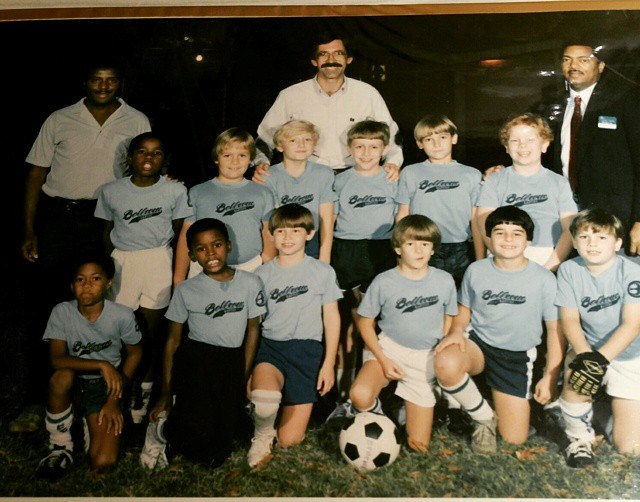
The Character of Sports

Bellevue Soccer TeamAs the (ridiculously) short winter in Texas appears to be giving way to spring, it is that time of year when parents start signing their kids up for sports teams. Since we live in a large metropolitan area, we have the luxury of choosing almost any sport at any time of year. Football, baseball, soccer, and basketball are virtually year-round activities here. At least once a year, my wife and I have a discussion about which activities to place our children in and for how long.

For many people, sports are an unhealthy obsession, but sports can actually be good for the development of character—if done the right way. Here are a few thoughts on the character that sports can build and some caveats for parents to go along with them.

Teamwork

While there are individual sports, we mostly think of team sports when we consider signing up our kids for a season. The beauty of such team sports is that they can counter the oppressive culture of individualism we often find in our society. Rather than spending time mindlessly staring at a screen with no consciousness of the world around them, children who play team sports get the opportunity to interact with other children in a (typically) competitive environment where they have to work together to accomplish a goal.

The level of teamwork varies with the sport, but one thing is consistent—the team is essential. No single child can compete against an entire team and be successful. For that matter, not even LeBron James could take the basketball court by himself and compete with even a decent college-level team.

Learning teamwork is important for our children because the “adult world” is full of interaction with others and collaboration to accomplish goals. From marriage to the workplace to church, we constantly interact with people for the sake of pursuing common goals.

As a leader, Moses learned this lesson from his father-in-law in Exodus 18. Jethro came to visit Moses in the wilderness and to bring his wife and sons back to him. While there, Jethro observed that Moses was handling all the disputes of the people by himself and advised him against such an approach. Jethro counseled him to “select out of all the people able men who fear God, men of truth, those who hate dishonest gain; and you shall place these over them as leaders of thousands, of hundreds, of fifties and of tens. Let them judge the people at all times; and let it be that every major dispute they will bring to you, but every minor dispute they themselves will judge. So it will be easier for you, and they will bear the burden with you. If you do this thing and God so commands you, then you will be able to endure, and all these people also will go to their place in peace” (Ex 18:21–23). Even the prophet Moses needed a team to accomplish the goal of judging the people and bringing them into the Promised Land.

The Warning for Parents

Children’s sports sometimes bring out the worst in parents. Many of us consider our child to be the next Peyton Manning, Derek Jeter, or Michael Jordan. However, our kids still need a team. They also need a team that respects them. When parents grandstand for their own child to be the focal point of the team, it actually does the child and the team a disservice. Camaraderie, selflessness, and unity are necessary for success on the field and in life. Even the most talented team can lose to another team that has learned to play together. Instead of promoting your own child, promote the team.

Discipline

I’ll never forget one of the coaches from my childhood. I didn’t really like him very much. He made us run long distances. If you were last, you might have to run another lap. He constantly worked on drills to teach skills. All I wanted to do was score (which I rarely did). Then he expected us to go home and work more between practices. I didn’t like what he required us to do. But he was teaching us the lesson of discipline.

Discipline is important in life, and sports have a built-in mechanism for teaching it—practice. Most kids are not blessed with the athletic ability to pick up the intricacies of a new game the first time they play. Yes, it may come easier to some than others, but even the best athletes practice (unless you’re Allen Iverson).

The discipline children learn in playing sports can translate to the rest of life. Schoolwork requires discipline. Jobs require discipline. Spiritual growth requires discipline.

Paul teaches us the lesson of spiritual discipline using illustrations from sports. He writes:

Do you not know that those who run in a race all run, but only one receives the prize? Run in such a way that you may win. Everyone who competes in the games exercises self-control in all things. They then do it to receive a perishable wreath, but we an imperishable. Therefore I run in such a way, as not without aim; I box in such a way, as not beating the air; but I discipline my body and make it my slave, so that, after I have preached to others, I myself will not be disqualified. (1 Cor 9:24–27)

Thus, sports can help children learn the discipline necessary for life. Team sports in particular teach us that others are dependent upon us exercising our own discipline.

The Warning for Parents

The danger for parents when it comes to discipline in sports is the tendency to fall into one of two extremes. We can demand perfection from our children that they simply cannot deliver or we can let them off the hook of practice and discipline. By always demanding absolute perfection, we may drive our children away from a desire to participate. By giving in to the temptation not to require practice, we may send our kids a message that practice and discipline are not necessary. Both extremes are problematic. Balance in this area is necessary.

Perseverance

One of my fondest sports memories came around the age of 9 or 10. I had been playing basketball in a church league for a few years already, but my church’s team was not very good. In fact, we had not won a game in more than two full seasons. But this game was different. By some miracle, we had actually taken the lead at the end of the game and just needed to run out the last few seconds on the clock. We were inbounding the ball from under the opponent’s basket and they were surrounding us to try to steal the ball. I broke open, caught the pass, and avoided the defense until time expired. We won! The taste of victory was sweet. It was even sweeter due to the lingering taste of defeat for more than two years.

Losing is a part of sports. Very few teams go undefeated. Learning to lose is an important lesson for life. It teaches perseverance. People who fail to learn how to pick themselves up after defeat tend to struggle mightily in life. At some point, we will be passed over for a promotion, or someone will critique what we say or write, or someone will tell us that our idea is a bad one. What we do when that happens says a lot about our perseverance.

Losing every game for two seasons was not fun, but most of our team stuck together. Over time we got better because we continued to discipline ourselves and trust one another. By the time we quit playing together in high school, we found ourselves in the city tournament.

In our spiritual lives, there will be trials and difficulties, but Scripture tells us to stand firm. Romans 5:3–5 reads, “[W]e also exult in our tribulations, knowing that tribulation brings about perseverance; and perseverance, proven character; and proven character, hope; and hope does not disappoint, because the love of God has been poured out within our hearts through the Holy Spirit who was given to us.”

The Warning for Parents

We as parents do not like to see our kids lose. As a result, some parents refuse to allow their children to play on a team that loses. At the first sign of a season turning south, they will pull their child off the team in order to find a better one—often bad-mouthing the coach on the way out. Another possibility is to blame the losses on someone else and never acknowledge our child’s role in the team’s loss. That doesn’t mean we need to be hyper-critical of our children’s faults, but we need to teach them where they can improve. I’m sure I cost my basketball team a number of games due to my abysmal free throw shooting. But that is why I spent afternoons in the driveway shooting free throws—at my dad’s suggestion. Failure is not fun, but it may be the best teacher.

This spring and summer, we will most likely have our kids in different sports and activities. I may even coach one of them. I hope they are successful, but I am more hopeful that they learn teamwork, discipline, and perseverance. Those are life skills they will take with them long after their days on the field or court are over.

_________________________

*Thanks to my friend and former teammate Achaz Foster for the “throwback” photo of one of our soccer teams back in the day. Yes, I’m the chunky kids second from the left on the back row.

Football and Family Dynamics

When I was a kid, I wanted to play professional football. I was an avid Chicago Bears fan, and I remember asking my parents to tape Super Bowl XX on our VCR. I wanted to see what the vaunted Bears defense would do to the hated Patriots (a hatred I still carry to this day). I wanted to see if William “Refrigerator” Perry would score a touchdown. I wanted to watch Walter Payton run for days in the big game. I probably even knew the words to the “Super Bowl Shuffle.” In fact, in first grade I remember writing one of those “What do you want to be when you grow up?” assignments and said that I wanted to play middle linebacker for the Bears like Mike Singletary. As the years went by, my athletic skills did not develop, nor did my body type fit the prototypical NFL middle linebacker. Oh well.

Even though my life and skills never matched the level necessary to rise to the ranks of NFL superstar, one aspect of my life does fit the mold—an intact family.

This week, ESPN released the results of a survey they conducted with 128 current and former NFL quarterbacks. Some of those surveyed include Super Bowl winners Peyton Manning, Eli Manning, Joe Flacco, and Russell Wilson. Among the retired quarterbacks surveyed were Hall of Famers Joe Namath, Bob Griese, and Steve Young.

Some of the questions included in the survey considered typical football-related topics, such as when they first threw a football, if they played in a spread offense in high school, and if they attended an instructional camp to develop skills or be seen by scouts. But the most interesting results to me were the ones about their families.

Nearly 90% of the quarterbacks surveyed came from 2-parent households!

In addition, over two-thirds of them came from families of 3 or more children. Thus, it seems that the typical NFL quarterback (including some of the best of all time) comes from what would be considered a larger family with both parents. ESPN reports:

[A]ccording to the Child Trends Databank, ‘the number and type of parents (e.g. biological, step) in the household, as well as the relationship between the parents, are strongly linked to a child’s well-being.’ Our survey did not seek details beyond the number of parents in the household, but the overwhelming presence of two parents (nearly 90 percent) in quarterback homes outpaced the overall nation average.

NFL quarterbacks seem to be passing over the top of all the cultural trends. Almost 41% of all children born in the United States today are born to unwed mothers. 37% of families with children under 18 do not include married parents.

In addition, the typical American family has less than two children today, but the typical quarterback comes from a family with 3 or more children. Perhaps one could see this as an advantage to have more receivers to throw the ball to and more defenders to allow him to practice avoiding the rush. No matter how you look at it though, the successful quarterback at the highest level of football comes from a family that is no longer normal in the United States. Instead, they come from traditional married families with more than the average number of children.

I can’t tell you how many parents are convinced that their kids are going to play professional sports when they get older. Some have even limited the size of their families in order to pour their energy and resources into giving a child or two that special opportunity. Some might even be willing to sacrifice their marriages in order for a child to hit that big payday in the NFL. But it seems from this research that the best place to start a pro career is by throwing the ball to your brothers and sisters in the yard while your mom and dad lovingly look on.

_________________________

Kevin Seifert, “Quarterback survey: What we learned,” ESPN.com, February, 4, 2015.

Centers for Disease Control and Prevention, “Unmarried Childbearing,” CDC.gov.

Jonathan Vespa, Jamie M. Lewis, and Rose M. Kreider, “America’s Families and Living Arrangements: 2012,” U.S. Census Bureau, August 2013.

U.S. Census Bureau, “Average number of own children per family (for families with own children under 18),” Census.gov.

Image credit: Jeffrey Beall, Flickr

Jesus and the American Sniper

The recent blockbuster movie, American Sniper, has already earned more than $253 million around the world since its release just a few weeks ago. The movie tells the story of Chris Kyle, a Navy SEAL sniper, who is considered to be the most deadly sniper in U.S. history. The film, directed by Clint Eastwood, is graphic in its depiction of the violence of war, but it also sheds light on the struggles of the man who became known as “Legend” on the battlefield.
Given its massive success at the box office, it comes as no surprise that American Sniper has generated quite a bit of controversy as well. What struck me as interesting (and saddening) was a recent back-and-forth between producer Michael Moore and Fox News commentator Todd Starnes, both of whom invoked the name of Jesus to defend their respective positions.

Michael Moore has openly opposed the film and stated via Twitter:

In these tweets, Moore implies that Chris Kyle participated in sinful, unbiblical, and un-Christian behavior by serving as a sniper in the American military during his four tours in Iraq. For those of you who recognize Moore’s work, such statements are probably expected in light of his political views.

On the other side of the spectrum, Todd Starnes responded to Moore’s tweets by focusing one of his “American Dispatch” commentaries on Moore’s views. In the middle of his commentary (starting at the 48 second mark), Starnes invoked the name of Jesus as well as he stated:

Well, I’m not theologian, but I suspect Jesus would tell that God-fearing, red-blooded American sniper, ‘Well done, thou good and faithful servant for dispatching another Godless jihadist to the lake of fire.’ But then again, I’m no theologian.

In stark contrast to the thoughts of Moore, Starnes concludes that Jesus would actually applaud Kyle for his work in the war and welcome him to heaven on the basis that he had personally ensured Islamic jihadists would end up in hell.

From a political perspective, I’d really have to hunt for a while to find much of anything to agree with Moore about. I’m probably going to line up with Starnes about 80–85% politically (although I often have problems with his rhetoric). However, in this case I think they both missed the point about Jesus.

I think Moore is asking the wrong questions for the most part. Would Jesus have participated in a war during his 30+ years on earth? Probably not. We have no record that he did and no reason to even speculate about it. However, Moore should be asking whether or not a legitimate government has the biblical authority to participate in war. On that question, the text of Scripture speaks fairly clearly. In Romans 13:1–4, Paul writes:

Every person is to be in subjection to the governing authorities. For there is no authority except from God, and those which exist are established by God. Therefore whoever resists authority has opposed the ordinance of God; and they who have opposed will receive condemnation upon themselves. For rulers are not a cause of fear for good behavior, but for evil. Do you want to have no fear of authority? Do what is good and you will have praise from the same; for it is a minister of God to you for good. But if you do what is evil, be afraid; for it does not bear the sword for nothing; for it is a minister of God, an avenger who brings wrath on the one who practices evil.

This passage has typically been interpreted to include a government’s right to take up arms and defend its citizens and the innocent. This authority is granted to the government by God. In Chris Kyle’s situation, he was acting as an agent of the government in an official capacity as a soldier. From the best we know, he only engaged enemy combatants in his role as a sniper. Thus, his actions seem to fall within the scope of the authority granted to government in Romans 13.

In his attempt to rush to Kyle’s defense, Starnes crosses the line by declaring that God is pleased with the fact that Kyle ushered unbelievers into a fiery judgment. The problem is that Starnes missed the point of the passage he quoted. Invoking the praise of the master from Jesus’ parable of the talents (Matthew 25:14–30), Starnes states that Kyle must have received a hero’s welcome in heaven upon his untimely death.

The problem here is that God does not rejoice in the death and judgment of those who do not trust in him. In 2 Peter 3:9 we read, “The Lord is not slow about His promise, as some count slowness, but is patient toward you, not wishing for any to perish but for all to come to repentance.” God does not rejoice in the condemnation of “another Godless jihadist to the lake of fire.” Instead, he is grieved that such a one never came to faith in Christ alone for salvation.

The fact of the matter is that war is a tragic consequence of the fall of mankind. War should never be pursued for its own sake. It should always be a last resort and a tragic necessity for the sake of restoring peace. Even though I believe waging just war is within the authority of the government, we should long for the day when there will be no more war. We learn about that day in Micah 4:3 where the prophet describes the last days as a time when “they will hammer their swords into plowshares and their spears into pruning hooks; nation will not lift up sword against nation, and never again will they train for war.” This is an eschatological reality, but it will only be realized after Christ returns. Until then, war will continue to be a part of this fallen world.

Finally, I want to address a point that Starnes made twice—he said he is not a theologian. By academic and professional standards, I guess you could say that I am a theologian. But so are you, and so is Mr. Starnes, and so is Mr. Moore. We are all theologians in one sense. When we approach the text of Scripture or declare what we believe (or don’t believe) about God, we are doing theology. Mr. Starnes may not have formally studied theology, and his theology in this particular commentary is weak in my opinion, but it is still theology.

Therefore, I would like to encourage us all to be careful when we apply the thoughts, words, or actions of Jesus to a particular situation. We need to make sure our theology is sound before we proclaim what Jesus would do or say.

Supreme Court to Decide Constitutionality of Same-Sex Marriage Laws

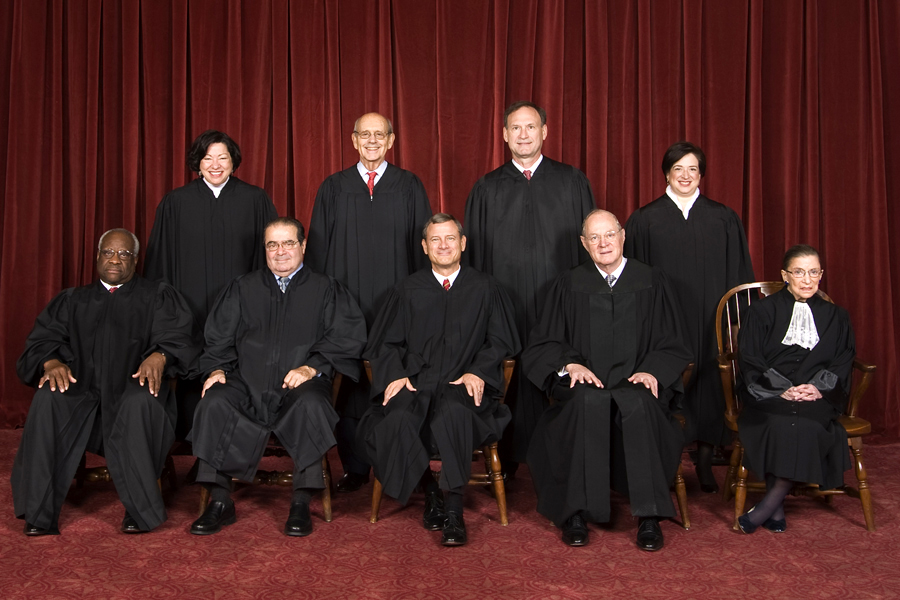
Supreme_Court_US_2010The Supreme Court has just announced that it will hear four cases involving the constitutionality of same-sex marriage laws around the United States. The hearings will most likely be in April with a decision in June.

Two central questions will be considered according to the Court’s statement granting certiorari:

  1. Does the Fourteenth Amendment require a state to license a marriage between two people of the same sex?
  2. Does the Fourteenth Amendment require a state to recognize a marriage between two people of the same sex when their marriage was lawfully licensed and performed out-of-state?

The answers to these questions will decide the future of marriage across the United States. If the answer to the first question is “Yes,” then same-sex marriage will be legalized nationwide, and the second question would be irrelevant. If the answer to the first question is “No,” but the second question is answered “Yes,” then it will authorize de facto same-sex marriage across the country. If both questions are answered “No,” then the status quo will continue.

The New York Times notes:

The pace of change on same-sex marriage, in both popular opinion and in the courts, has no parallel in the nation’s history.

Based on the court’s failure to act in October and its last three major gay rights rulings, most observers expect the court to establish a nationwide constitutional right to same-sex marriage. But the court also has a history of caution in this area.

This could be one of the most pivotal decisions of the Supreme Court in a generation. It will impact the future of marriage in this nation for generations to come. This is a time for us to be in earnest prayer for the justices of the Supreme Court. I pray that they will uphold the design for marriage that God has created and has been recognized for all of human history up to the last decade. The future of marriage is at stake.

_________________________

Supreme Court Order 574 U.S., January 16, 2015.

Adam Liptak, “Supreme Court to Decide Whether Gays Nationwide Can Marry,” The New York Times, January 16, 2015.

Lyle Denniston, “Court will rule on same-sex marriage,” SCOTUSblog, January 16, 2015.

Next Stop, Supreme Court (?)

wedding ringsA panel of the 6th Circuit Court of Appeals upheld the traditional definition of marriage today in cases involving Michigan, Ohio, Tennessee, and Kentucky. This is the first time in the recent round of cases that a circuit of the U.S. Court of Appeals has ruled in favor of laws limiting marriage to one man and one woman. This also creates a point of tension for the Supreme Court since they decided last month not to take up other cases related to the definition of marriage.

Robert Barnes reports the following in The Washington Post:

A panel of the U.S. Court of Appeals for the 6th Circuit upheld same-sex marriage bans in four states Thursday afternoon, creating a split among the nation’s appeals courts that almost surely means the Supreme Court must take up the issue of whether gay couples have a constitutional right to marry.

The panel ruled 2 to 1 that while gay marriage is almost inevitable, in the words of U.S. Circuit Judge Jeffrey Sutton, it should be settled through the democratic process and not the judiciary. The decision overturned rulings in Michigan, Ohio, Tennessee and Kentucky, and makes the 6th Circuit the first appeals court to uphold state bans since the Supreme Court in 2013 struck down part of the federal Defense of Marriage Act.

In the conclusion of the majority opinion, U.S. Circuit Judge Jeffrey Sutton chastises the courts that have overturned marriage laws in other states. He writes:

When the courts do not let the people resolve new social issues like this one, they perpetuate the idea that the heroes in these change events are judges and lawyers. Better in this instance, we think, to allow change through the customary political processes, in which the people, gay and straight alike, become the heroes of their own stories by meeting each other not as adversaries in a court system but as fellow citizens seeking to resolve a new social issue in a fair-minded way.

Now there is a split in the U.S. Circuit Courts. Now we have to wait and see if the Supreme Court will take up the cases.