Christian Post Interview about Theological Arguments for Homosexuality

Matthew Vines

A few weeks ago, one of my students sent me a link to a video and transcript of a young man from Harvard University who was making a case for why the Bible does not condemn homosexuality. My student was hoping that I could especially address the meaning of Romans 1:26-27. I quickly perused the transcript and sent a copy of an article I wrote a few years ago.

Fast forward almost three weeks, and our Communications Office at SWBTS got an email from a reporter at The Christian Post asking for a professor to answer some questions related to that same video. The seminary asked me to respond.

Today, the article was released, and it included a significant amount of my responses. I would like to encourage you to read the article. I am honored to be included with the likes of Robert Gagnon (Pittsburgh Seminary), Sean McDonough (Gordon-Conwell Seminary), and Richard Mouw (Fuller Seminary). It is the second part of a three-part series. The first was an interview with the student from Harvard, Matthew Vines. In the days to follow, I will also post the full text of my answers to the questions.

_________________________

Lillian Kwon, “Theologians Find Vines’ ‘Homosexuality Is Not a Sin’ Thesis Not Persuasive,” The Christian Post, September 28, 2012.

Stoyan Zaimov, “Matthew Vines: Bible Does Not Condemn Homosexuality,” The Christian Post, September 25, 2012. (Part 1 of the series)

Matthew Vines, “The Gay Debate: The Bible and Homosexuality,” matthewvines.com.

Professor Regnerus Exonerated by University of Texas

Over the summer, Professor Mark Regnerus (University of Texas at Austin) published a paper noting some negative outcomes for children of parents who had same-sex relationships compared to children from biologically intact families. His findings contradict previous research based on much smaller sample sizes that claimed there was no difference in children raised in traditional families and those raised by parents in same-sex relationships. Immediately after the paper was published, Regnerus faced a firestorm of criticism that culminated in formal allegations of scientific misconduct by a blogger known for promoting a homosexual agenda. The University of Texas initiated a formal inquiry, and the results have been made public–there is insufficient evidence to warrant a formal investigation.

Reading the official report from the University sheds clear light on the issue. In part, the report states:

None of the allegations of scientific misconduct put forth by Mr. Rose were substantiated either by physical data, written materials, or by information provided during the interviews. In brief, Mr. Rose believed that the Regnerus research was seriously flawed and inferred that there must be scientific misconduct. However, there is no evidence to support that inference.

While much has been said about the accusations against Regnerus, little has been reported about his exoneration. In essence, unsubstantiated allegations were made against Regnerus by someone who disagreed with his conclusions. Based on his disagreement, Mr. Rose sought to have Regnerus disciplined or even removed from the faculty. While the inquiry was most certainly a burden to the professor, I am sure he is thankful that the integrity of his research was upheld.

Given the scope of Regnerus’ research and the controversial conclusions, I am sure his findings will be debated in the future. However, it should be made clear that any attempt to discredit him or his research on the basis of politics has been declared as unsubstantiated.

I am thankful for Mark Regnerus and his work showing the impact of same-sex parents on children and the value of traditional marriage and family structures for children and society at large.

_________________________

Regnerus Inquiry Report,” University of Texas at Austin, August 24, 2012.

University of Texas at Austin Completes Inquiry into Allegations of Scientific Misconduct,” University of Texas at Austin, August 29, 2012.

Jennifer Marshall, “Case Closed at UT Austin: Regnerus Exonerated,” The Foundry, August 31, 2012.

Mark Regnerus, “How different are the adult children of parents who have same-sex relationships? Findings from the New Family Structures Study,” Social Science Research 41 (2012): 752-770.

Genetic Screening for Ethical Babies

In the most recent issue of the British Reader’s Digest, Professor Julian Savulescu argues that parents may have a moral obligation to genetically engineer babies with more ethical traits. With the advances in medical technology and genetic screening, Savulescu believes that couples can use genetic mapping of embryos in combination with in-vitro fertilization (IVF) to ensure that their children do not exhibit traits that may be harmful to themselves and others.

While rejecting the coercive tactics of previous eugenics practices, Savulescu states:

Modern eugenics, from testing for diseases to deciding whether you want a girl or boy, is voluntary. So where genetic selection aims to bring out a trait that clearly benefits an individual and society, we should allow parents the choice. To do otherwise is to consign those who come after us to the ball and chain of our squeamishness and irrationality.

Notice his language here. He believes that squeamishness and irrationality (admittedly traits found in many humans for the entire history of mankind) are a “ball and chain” on society. Such undesirable traits apparently prevent progress for the human race.

However, Savulescu does not stop at the idea of progress. He continues his “moral” argument with the idea of obligation. He writes:

Indeed, when it comes to screening out personality flaws, such as potential alcoholism, psychopathy and dispositions to violence, you could argue that people have a moral obligation to select ethically better children. They are, after all, less likely to harm themselves and others.

This moral case for genetic engineering comes on the heels of an announcement about the first whole-genome sequencing of a fetus. Savulescu believes that in the next five years, we will “be able to screen for every gene that determines who we are physically and psychologically.”

What should we make of this call for genetic engineering to produce “ethical” babies? First, we need to evaluate Savulescu’s worldview. It is clear from his brief article that he holds to a naturalistic worldview. He believes that the material world is the only reality. He has no room for God or the supernatural in his view. He even subtly mocks the idea of God when he states, “Some people believe that babies are a gift, of God or nature, and that we shouldn’t mess with their genetic make-up. But most of us already implicitly reject this view.”

Within his worldview, progress seems to be the ultimate goal. He never really defines progress apart from an ethic of non-malevolence. As long as people are not harming themselves or others, Savulescu seems to be satisfied.

Another commitment that seems evident in this proposal for genetic engineering is the idea of genetic determinism. This is the concept that man is simply a collection of genetic material. His personality, intelligence, relationships, etc., are determined completely by his genetic makeup. If this genetic makeup could be altered or enhanced, then we could generate a race of superior individuals. Even though Savulescu would not go so far as to say that we are required to take part in this genetic manipulation, he does believe we have a moral obligation to do so.

Francis Schaeffer noted similar trends in the thinking of Francis Crick (famed for discovering the DNA code with James Watson) forty years ago. Schaeffer writes:

Philosophically, therefore, Francis Crick is a reductionist—that is, one who would reduce man from a complex personal being made in the image of God to an electro-chemical machine. Unfortunately, such a notion not only makes man meaningless but soon leads to the idea that man can, and just as well may, be manipulated with impunity.

This very manipulation is what Savulescu desires to see. But more than that, he believes it is the morally right thing to do as parents. He states:

Screening embryos like this is illegal at present, but isn’t rational design something we should welcome? If we have the power to intervene in the nature of our offspring—rather than consigning them to the natural lottery—then we should. Surely trying to ensure that your children have the best, or a good enough, opportunity for a great life is responsible parenting?

While Savulescu objects to the forced sterilization and extermination of the “genetically unfit” from the days of Nazi eugenics programs, he still leaves the door open to some authority declaring that such a “moral obligation” should be enforced. He proclaims, “Whether we like it or not, the future of humanity is in our hands now. Rather than fearing genetics, we should embrace it. We can do better than chance.”

We need to recognize with Schaeffer that man is a complex personal being made in the image of God (Gen 1:27). We are more than DNA and chemical bonds. We have souls. And despite Savulescu’s praise for technology, genetic engineering cannot undo the effects of the fall (Gen 3). We are sinners. We often act in opposition to our own rational thought. We seek after our own desires—many times to the detriment of others and ourselves. Genetic screening will not solve this problem. Only Christ conquers sin.

_________________________

Julian Savulescu, “The Maverick: ‘It’s Our Duty to Have Designer Babies,’” Reader’s Digest (British edition), August 21, 2012.

Richard Alleyne, “Genetically engineering ‘ethical’ babies is a moral obligation, says Oxford professor,” The Telegraph, August 16, 2012.

Francis A. Schaeffer, Back to Freedom and Dignity, in vol. 1 of The Complete Works of Francis A. Schaeffer (Wheaton: Crossway, 1985).

*Image credit: Ben Birchall/PA, The Telegraph

This is a good article from SWBTS student and Land Center research associate, Trey Dimsdale.

treydimsdale's avatarLaw and the Created Order

I had the privilege of traveling to San Diego, CA last month to attend the Ruth Institute’s It Takes a Family to Raise a Village Conference.   The conference is targeted at college-aged students and provides them the opportunity to learn from and interact with very notable scholars who work in the field of marriage and family in their respective disciplines.  Speakers included economists, attorneys, activists, a medical doctor, and theologians all presenting persuasive arguments in support of natural, man/woman marriage.  I wish a similar program had been available when I was a college student and even more, I hope that if it had, I would have had the wisdom to avail myself of it.

The highlight of the weekend in my estimation was a conversation between Drs. Robert Gagnon (of Pittsburgh Theological Seminary) and Jennifer Roback Morse (of the Ruth Institute) and The Rt. Rev. Gene Robinson (Bishop of the…

View original post 971 more words

Words of Wisdom from Sam Houston

We have a terrible habit as Americans of forgetting history. Perhaps it is due to the fact that our national history is so brief when compared to other nations. However, there are many lessons we can learn from our short history. Our elected officials should periodically consider the wisdom of their predecessors from centuries past.

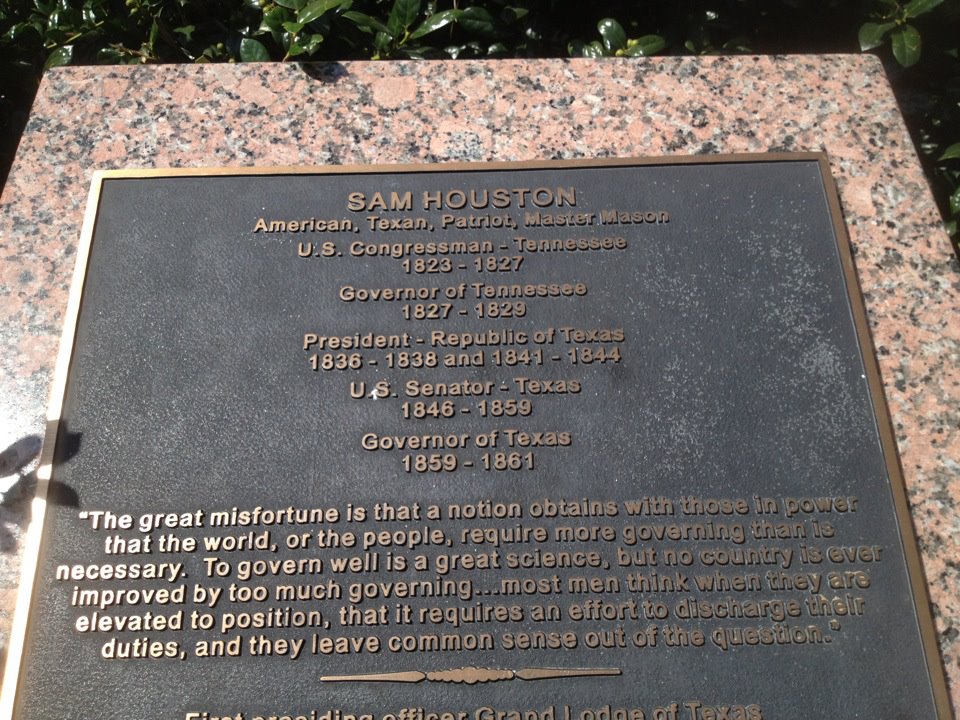
On a recent vacation, our family stopped at the massive statue of Sam Houston in Huntsville, TX along I-45. On the plaque at the base of the statue, there was a quote from Houston. In light of the current political campaign season, I believe this quote is very pertinent to the United States

The great misfortune is that a notion obtains with those in power that the world, or the people, require more governing than is necessary. To govern well is a great science, but no country is ever improved by too much governing…most men think when they are elevated to position, that it requires an effort to discharge their duties, and they leave common sense out of the question.

-Sam Houston, President of Republic of Texas, Governor of Texas, Governor of Tennessee, U.S. Congressman-TN, U.S. Senator-TX