History, the Supreme Court, and Same-Sex Marriage

The 9 justices of the Supreme Court of the United States

For the last two days I have been telling my classes that we are living history in this moment. Most of us take little notice of the oral arguments being made before the Supreme Court of the United States. We recognize few of the names of cases, and even fewer names of those who have served as justices. However, Hollingsworth v. Perry and United States v. Windsor may become as familiar as Roe v. Wade or Lawrence v. Texas. In fact, the names Scalia, Kennedy, Thomas, Ginsburg, Breyer, Roberts, Alito, Sotomayor, and Kagan may become quite familiar through the years. Much of the historical significance of these cases and justices hinges not on what happened during the oral arguments on March 26–27, 2013, but on the written opinions that will likely be released in June.

The two cases, Hollingsworth v. Perry and United States v. Windsor, address one of the most controversial cultural issues of our day—same-sex marriage. Hollingsworth takes up the question of California’s Proposition 8 and whether the voter referendum approved in 2008 which outlawed same-sex marriage in the state can stand. The Windsor case is the challenge against the federal Defense of Marriage Act (DOMA) passed by Congress in 1996 and signed into law by President Bill Clinton. DOMA restricts federal marriage benefits to heterosexual marriages and only requires states to recognize heterosexual marriages.

I am the son of an attorney but not one myself so I will not attempt a legal analysis of the cases; however, I want to address some of the cultural and ethical implications of the debate.

First, the heart of the debate is the definition of marriage. As noted by Theodore B. Olson, attorney for the couples challenging Prop 8, “the label ‘marriage’ means something.” Mr. Olson is correct. Marriage has a meaning. In his argument, he tried to convince the justices that civil unions were not enough—marriage was the only acceptable label for his clients’ relationships. Chief Justice John Roberts responded to Mr. Olson by stating, “If you tell a child that somebody has to be their friend, I suppose you can force the child to say, ‘This is my friend.’ But it changes the definition of what it means to be a friend.”

Chief Justice Roberts went straight to the core issue. What is the meaning of marriage? There are essentially two approaches. Supporters of same-sex marriage typically define marriage as an intimate, emotional union between individuals. This definition would open the door to marriage for members of the same sex who self-identify as homosexual. The only standard for marriage would be emotional intimacy. By contrast, defenders of traditional marriage define marriage much more specifically than emotional union. In their book, What Is Marriage? Man and Woman: A Defense, Girgis, Anderson, and George offer what they call the conjugal definition of marriage:

There is a distinct form of personal union and corresponding way of life, historically called marriage, whose basic features do not depend on the preferences of individuals or cultures. Marriage is, of its essence, a comprehensive union: a union of will (by consent) and body (by sexual union); inherently ordered to procreation and thus the broad sharing of family life; and calling for permanent and exclusive commitment, whatever the spouses’ preferences.

Chief Justice Roberts implied by his comment that allowing same-sex marriage would completely change the definition of the term “marriage.” The change would be so significant that the historical understanding of marriage would no longer apply. This is a key element of the debate. Attaching the term “marriage” to same-sex relationships so changes the meaning of the term that it no longer carries any of its historical meaning and context.

Girgis, et al, make a couple of key observations in their definition. Marriage is comprehensive. It involves all aspects of life. It is expressed through sexual intercourse that is directed to procreation. Of course, not all heterosexual intercourse results in procreation, but all homosexual intercourse is biologically incapable of procreation. The procreation of children and rearing them are then part of the meaning of marriage, but once again, same-sex partners cannot produce their own biological children. Only in recent years, same-sex couple adoption and reproductive technologies using donor sperm or eggs have made child-rearing by same-sex couples even possible.

A change to the historical definition of marriage is required for same-sex marriage to be legalized. It is not just using the term for a new type of relationship. It is a complete change in the meaning of the term.

Second, the legalization of same-sex marriage will lead to other distortions of marriage. Most of the proponents for same-sex marriage ignore the logical implications of any legal success on their part. They believe same-sex marriage should be fairly monogamous and would never imply other forms of marriage. However, their logic is inconsistent. By redefining marriage as an intimate, emotional bond, there is no limit placed upon who can get married and how many. The legalization of same-sex marriage opens the door to polygamy, polyamory, and incestuous marriage.

Is that not simply an overreaction? Not at all. In fact, there is already a federal lawsuit in Utah calling for the decriminalization of bigamy using the exact logic of same-sex marriage. If an emotional bond between two men or two women can be called marriage, why not an emotional bond between one man and two women, or two men and one woman, or two men and two women? Or what about an emotional bond between a brother and sister or two cousins? The revised definition of marriage places no logical or biological limits.

Third, many proponents of same-sex marriage have employed civil rights language to support their cause. However, same-sex marriage is not a civil right. One of the biggest differences between the civil rights movement of the 1960’s and same-sex marriage is that the minority seeking protection today are only known by self-identification. Voddie Baucham summarizes it this way:

Determining whether or not a person is black, Native American, or female usually involves no more than visual verification. However, should doubt remain, blood tests, genetics, or a quick trip up the family tree would suffice. Not so with homosexuality. There is no evidence that can confirm or deny a person’s claims regarding sexual orientation.

If “protected class” status can only be determined by self-identification, there is no way to protect that class. In fact, that class truly does not exist in the legal sense because it cannot be identified. Co-opting the language of civil rights for this debate is an offense to minorities of all types, especially African Americans who fought so hard to gain equal rights (including the right to marry members of other ethnicities) decades ago.

So what can Christians do about this? Our first step is to affirm the truth of Scripture. Beginning in Genesis, all statements about marriage involve a man and a woman. Genesis 2:24 declares, “For this reason a man shall leave his father and his mother, and be joined to his wife; and they shall become one flesh.” Jesus affirmed heterosexual marriage in Matthew 19:4–6 as he states, “Have you not read that He who created them from the beginning made them male and female, . . . [quotes Gen 2:24]? So they are no longer two, but one flesh. What therefore God has joined together, let no man separate.” From the Old Testament to the New Testament, Scripture teaches marriage as a lifelong covenant between one man and one woman. We need to teach this and live it out.

Next, we need to address the sin of homosexuality. Romans 1:26–27 clears identifies homosexuality as a sin. Paul writes:

For this reason God gave them over to degrading passions; for their women exchanged the natural function for that which is unnatural, and in the same way also the men abandoned the natural function of the woman and burned in their desire toward one another, men with men committing indecent acts and receiving in their own persons the due penalty of their error.

However, homosexuality is not the unpardonable sin. Paul makes an interesting observation in 1 Corinthians 6:9–11. After giving a list of sins describing the unrighteous—including the sin of homosexuality—in v. 9–10, Paul states in v. 11, “Such were some of you; but you were washed, but you were sanctified, but you were justified in the name of the Lord Jesus Christ and in the Spirit of our God.” Even in the church in Corinth, there were former homosexuals. Their lives had been characterized by such sin, but no longer. It is our responsibility to declare the life-changing truth of the gospel and allow the Holy Spirit to do his work.

I want to remind us once again that we are living history. We are watching the world change before our very eyes. How will the Supreme Court decide? No one knows at this point. The implications, however, are clear. This will impact our culture, but God’s Word never changes. May we declare his Word with boldness no matter the cost.

_________________________

Adam Liptak, “Justices Say Time May Be Wrong for Gay Marriage Case,” The New York Times, March 26, 2013.

Sherif Girgis, Ryan T. Anderson, and Robert P. George, What Is Marriage? Man and Woman: A Defense (New York: Encounter, 2012), 6.

Voddie Baucham, “Gay Is Not the New Black,” The Gospel Coalition, July 19, 2012.
The Associated Press and the Normalization of Same-Sex Marriage

Last week the Associated Press (AP) notified its constituents of a new entry in the AP Stylebook. This new entry addresses the appropriate use of the terms husband and wife. The text of the entry is:

husband, wife Regardless of sexual orientation, husband or wife is acceptable in all references to individuals in any legally recognized marriage. Spouse or partner may be used if requested.

This entry has been officially added to the online version of the AP Stylebook and will appear in the print edition later this spring.

The Associated Press is perhaps the most influential news organization in the world. Their stories and photos have run in news outlets since 1846. The AP Stylebook (first published in 1953 and updated annually) serves as the standard style guide for journalists. As a result, the choices the Stylebook makes in the use of language impact how readers and listeners of news media will view issues.

In a press release on the new Stylebook entry, Mike Oreskes, AP Senior Managing Editor for U.S. News, stated,

The AP has never had a Stylebook entry on the question of the usage of husband and wife. All the previous conversation was in the absence of such a formal entry. This lays down clear and simple usage. After reviewing existing practice, we are formalizing ‘husband, wife’ as an entry.

I find the comment by Mr. Oreskes to be quite interesting. For 50 years, the Associated Press had never seen a reason to post an entry regarding the usage of husband and wife. However, now they determine there is a need for such an entry, and it reflects a change to the long held understanding of marriage in our society. I would argue that the reason no entry was needed previously is that society at large clearly understood the meaning and usage of husband and wife. A husband and wife are the two individuals in a marriage. The husband is male, and the wife is female. It was understood that a husband would have a wife and a wife would have a husband.

However, in this age of attempts to redefine marriage, the AP has determined it will weigh in on the matter. Notice the language of the entry. It reads, “Regardless of sexual orientation, husband or wife is acceptable in all references to individuals in any legally recognized marriage.” Thus, journalists can use AP-approved style to refer to two husbands or two wives. They could, perhaps, even refer to the two individuals in a same-sex marriage as husband and wife with the approval of the couple if that is how the individuals view their roles in that “marriage.”

The AP has jumped into the fray with an agenda to normalize same-sex marriage in society through the use of language in journalism. What I find ironic in all of this is the tag at the end of the press release describing the AP. It reads:

The Associated Press is the essential global news network, delivering fast, unbiased news from every corner of the world to all media platforms and formats. Founded in 1846, AP today is the most trusted source of independent news and information. On any given day, more than half the world’s population sees news from AP. On the Web: www.ap.org.

There are a few adjectives that the AP uses to describe itself that are violated in their latest addition to the Stylebook. They claim to be a “global news network,” to deliver “unbiased news,” and to be a “trusted source of independent news and information.”

As a “global news network,” surely the AP is aware that same-sex marriage is not a global norm. In fact, most of the world does not recognize same-sex marriage as legitimate. Delivering “unbiased news” means that it is free of political agendas, yet there is hardly a more vocal political group than the homosexual community attempting to normalize their lifestyle. Finally, a “trusted source of independent news and information” will refrain from promoting a particular viewpoint over other valid options. In making this change to the Stylebook, the Associated Press has violated all three of these descriptions for its own mission.

The normalization of same-sex marriage (and homosexuality in general) has been a goal of the homosexual community for decades. They have often found a sympathetic ear among journalists, especially those whose politics lean to the left. However, they have now found support from the “essential global news network” known as the Associated Press. Despite the fact that the AP claims to be unbiased and independent, it has now voiced an opinion in this matter. The opinion was placed in the most subtle of places—a journalistic style manual. I dare say this was not by accident. Why make a public policy statement when you can simply change the use of language?

In Matthew 10:16, Jesus told his disciples, “Behold, I send you out as sheep in the midst of wolves; so be shrewd as serpents and innocent as doves.” As Christians, we tend to do fairly well on being “innocent as doves,” but we often lack the shrewdness of serpents. This is a time when we need to be shrewd and attentive to our culture so that we are prepared to defend the biblical model of marriage as it is being attacked on all sides.

_________________________

New entry in the AP Stylebook: husband, wife,” Associated Press, February 21, 2013.

*Special thanks to Benjamin Hawkins, Senior Writer in the Office of Communications at Southwestern Baptist Theological Seminary, for bring this announcement to my attention.

Use of “Morning-After Pill” on the Rise

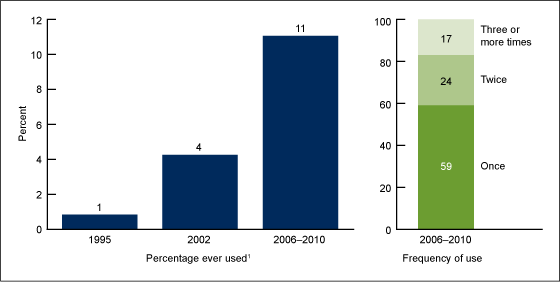
Percentage of sexually experienced women aged 15–44 who have ever used emergency contraception: United States, 1995, 2002, and 2006–2010, and frequency of use among women who have ever used emergency contraception, 2006–2010. SOURCES: CDC/NCHS, National Survey of Family Growth, 1995, 2002, and 2006–2010.

The Centers for Disease Control and Prevention released a report last week that flew under the radar of most news organizations. They conducted a five-year study (2006–2010) on the use of the “morning-after pill” (labeled “emergency contraception” in the study—more on that later) and found that 11% of “sexually experienced women aged 15–44 . . . had used emergency contraception, up from 4.2% in 2002.” Thus, in less than ten years, use of this form of birth control has almost tripled.

Other facts released in the study include:

  • Most women who had ever used emergency contraception had done so once (59%) or twice (24%).
  • Young adult women aged 20–24 were most likely to have ever used emergency contraception; about one in four had done so (23%).
  • Almost 1 in 5 never-married women (19%), 1 in 7 cohabiting women (14%), and 1 in 20 currently or formerly married women (5.7%) had ever used emergency contraception.
  • Non-Hispanic white and Hispanic women were more likely to have ever used emergency contraception (11%) compared with non-Hispanic black women (7.9%).
  • Ever-use of emergency contraception increased with educational attainment—12% of women with a bachelor’s degree or higher and 11% of women with some college education had ever used it. This compares with 7.1% of women who had a high school diploma or GED and 5.5% of women with less than a high school education.

We can make a few key observations from this report. First, emergency birth control is on the rise. As this method of eliminating an unplanned pregnancy has become more normalized, the rates of use have gone up significantly.

Second, the use of emergency birth control is especially high in women in their 20’s. As the median age of first marriage gets older (28.7 for men and 26.5 for women as of 2011), the number of unmarried women having a sexual relationship increases. Most of those desire to avoid pregnancy and opt for emergency solutions when other methods fail or are not employed. This trend is likely to continue as marriage and children become less of a norm.

Third, education seems to increase the likelihood of using emergency birth control even though it also increases the likelihood of marriage. Despite the fact that married women are less likely to use the morning-after pill and women with more education tend to get married, the two trends do not track together. It is possible that those with more education using the emergency birth control are moving towards marriage but have not yet arrived at that stage.

So what should we make of this? Does this represent the demise of family and biblical sexuality in American culture? Should the church even be concerned?

In short, the church should be concerned on a few different levels. This issue is not going away any time soon, so we need to be prepared to address it. Let me note a few items for us to consider.

The first issue is a terminology problem. As evidenced in the report, the morning-after pill is labeled as emergency contraception. However, this is inaccurate. Contraception, by its very definition, is something that prevents conception. Plan B, Ella, and other forms of this pill are intended to prevent pregnancy after intercourse; thus, taking into account that fertilization may have already occurred. Therefore, they should be called birth control (preventing birth) rather than contraception.

The second issue is a life problem. The CDC report notes, “Emergency contraception can be used by women after sexual intercourse in an effort to prevent an unintended pregnancy. Roughly one-half of all pregnancies in the United States are unintended.” Intended or unintended, pregnancies represent lives. Innocent human life in the form of a developing baby in the womb is that which is eliminated by emergency birth control. Those who are in favor of protecting unborn life should stand in opposition to the proliferation of these drugs. Unfortunately, our culture views children more as commodities than lives. They are financial investments and burdens rather than blessings (Psalm 127:3–5). We need to return to a biblical perspective on children and life in the womb.

The third problem is the lack of information in the church. Birth control is one of those issues we just don’t talk about. However, nearly a quarter of the women aged 20–24 in the survey had used emergency birth control. It’s a tough issue. You are talking about life, reproduction, medical decisions, and other aspects of the private lives of women all at the same time. Just because it is difficult, though, does not mean we should avoid it. My guess is that many of these women represent churches all across the United States. In fact, there are probably women scattered throughout Southern Baptist congregations who have used this form of birth control.

We need to talk about it. We need to inform our people. We need to protect life. In and of itself, it may not represent the demise of marriage and family in culture, but it certainly speaks to a trajectory we are currently on.

_________________________

Kimberly Daniels, Jo Jones, and Joyce Abma, “Use of Emergency Contraception Among Women Aged 15–44: United States, 2006–2010,” Centers for Disease Control and Prevention, February 2013.

UK on Verge of Approving Same-Sex Marriage

Photo by DAVID ILIFF (Wikipedia Commons)

CNN has reported that the British Parliament has taken initial steps to make same-sex marriage legal in the United Kingdom. In spite of strong resistance by Prime Minister David Cameron’s Conservative Party, the measure received an initial vote of approval 400-175. According to the report, the measure must still receive another vote in the House of Commons and a vote in the House of Lords.

While the Conservative Party in the UK has opposed the legislation, Prime Minister Cameron has been supportive of the measure. He has considered it to be an issue of equality while still claiming to support marriage.

This should prove interesting since the Church of England officially opposes the legislation, yet it is the state church. CNN notes:

As drafted, the bill would enable religious organizations to choose to conduct same-sex marriages if they wish and includes provisions intended to make sure no religious organization or person is forced to do so.

The Church of England is among the religious bodies opposed to the legislation.

The Church of England also sent a brief to Parliament citing its objection. The news report states:

The Church of England also outlined its objections to the bill in a briefing note sent to lawmakers Friday.

It cannot support the legislation “because of its concern for the uncertain and unforeseen consequences for wider society and the common good when marriage is redefined in gender-neutral terms,” it said.

While the reported objection is probably not the full reasoning, the Church of England brings up a good point. When marriage becomes gender-neutral, it is automatically separated from procreation. Marriage is then defined in terms of emotion. Once intensity of emotional bond becomes the definition of marriage, other forms of marriage must be approved. These include polygamy, polyamory, and ultimately incestuous marriage.

This will be a big defeat for supporters of traditional marriage. It will also prove to be a source of tension for the Church of England as it attempts to serve as the state church while opposing the law. My guess is that the Church of England (in England) will ultimately be forced to comply if this law is enacted.

We will be well-served to see what happens in the UK because it may be the future in the United States.

_________________________

Laura Smith-Spark and Atika Shubert, “UK lawmakers approve same-sex marriage in first vote,” CNN.com, February 5, 2013.

Boy Scouts of the New America

Photograph of President Truman in the Oval Office receiving a report on the accomplishments of the Boy Scouts from a delegation of Eagle Scouts, who are giving him the Boy Scout salute. (National Archives and Records Administration)

The Boy Scouts of America are scheduled to make a decision this week on their membership policy. This could prove to be a significant shift in policy that has the potential to impact the future of scouting.

Last week, Deron Smith, director of public relations for Boy Scouts of America, announced that “the BSA is discussing potentially removing the national membership restriction regarding sexual orientation.” Prior to this announcement the Boy Scouts have maintained a policy that prohibits membership for homosexual scouts and troop leaders. As recently as July 2012, the Boy Scouts had affirmed their membership policy as “absolutely the best policy for the Boy Scouts.”

In place of their national policy prohibiting the membership of homosexuals, the BSA may implement a localized policy where “the chartered organizations that oversee and deliver Scouting would accept membership and select leaders consistent with each organization’s mission, principles, or religious beliefs. BSA members and parents would be able to choose a local unit that best meets the needs of their families.” In essence, each local organization that sponsors a Boy Scout troop would have the ability to set its own policy regarding sexual orientation.

The merits (or demerits) of this potential policy shift have been discussed in the media and will continue to be the subject of evaluation in the days to come. However, I want to ask the question: Does this potential policy change by the Boy Scouts represent the face of the “New America”?

What is the New America? The proposed policy of the Boy Scouts gives us a guide for what the New America looks like.

First, in the New America convictional beliefs are discarded for the sake of avoiding cultural pressure. There is no doubt that the Boy Scouts have faced extreme pressure from the homosexual community to change their policy. Even after a decision from the Supreme Court in 2000 that allowed the Boy Scouts to maintain their membership policy, the pressure has grown. At this point, however, at least some of the pressure has been building from the executive board where two prominent members have expressed publicly that they would work towards ending the policy.

Unfortunately, discarding convictional beliefs for the sake of avoiding cultural pressure is a hopeless cause. For the Boy Scouts, many of their sponsoring organizations (churches, schools, and civic groups) will now face pressure to include homosexual scouts and leaders in direct opposition to their own beliefs. Unlike the national organization with the time, resources, and money to fight the challenges, these local groups will either capitulate to the pressure or drop their sponsorship. Effectively, the national organization will suffer because they are unwilling to stand up in the face of pressure.

Second, in the New America decision-makers refuse to take responsibility for those under their authority. President Harry S. Truman famously had a sign on his desk in the White House which read, “The buck stops here!” Implied in that phrase were the ideas that tough decisions were made here and the blame for those decisions could not be passed along to someone else. It appears that the Boy Scouts have chosen to pass the buck with their new proposed policy. Rather than taking responsibility for the hard decision (either keeping the policy in place or directing the sponsoring organizations to abide by a new policy), the national organization has passed responsibility down the line. This is not the natural line of progression for responsibility. Responsibility increases as one moves up the chain of command. There is no doubt that a scoutmaster would take responsibility for his troop rather than allowing the scouts to do what is right in their own eyes.

This failure to take responsibility is nothing new to the human race. When asked by God if he had eaten fruit from the tree about which God had commanded him not to eat, Adam replied, “The woman who You gave to be with me, she gave me from the tree, and I ate” (Genesis 3:12). Adam failed to take responsibility and blamed Eve, yet he still suffered the consequences of his sin. In the same way, the national BSA may feel that they can dodge the consequences of making a decision by placing the burden upon the local organizations; however, their day will come, either through a plethora of lawsuits or an exodus of sponsoring organizations.

Finally, in the New America disagreement equals hatred and bigotry. On controversial issues, such as homosexuality, disagreement is often equated with intolerance and labeled as hate speech, bigotry, or a danger to society. For example, Richard Ferraro, vice president for communications for the Gay and Lesbian Alliance Against Defamation (GLAAD), granted an interview to the New York Times. In part his statement read, “Prohibiting or ejecting gay children or leaders sends a dangerous message to all children, Mr. Ferraro said, adding, ‘It’s policies like this that contribute to bullying in schools.’” The appeal here is not to logic and reason (or even the legal right that BSA has to exclude certain people). Instead, Ferraro has equated the membership policy to bullying. His analogy is replete with fear, danger, and hatred.

The days of civil public discourse appear to be fleeting. Respectful disagreement is no longer tolerated. The Boy Scouts had previously staked their claim on this issue in a respectful, yet clear, manner. However, that policy has fallen out of fashion in American culture. In the face of accusations of being bullies, bigoted, and out-of-touch, the BSA is on the verge of yielding to the loudest voices in our culture. They do not seem to be up to the task of making their case in a reasoned, balanced argument.

We will find out later this week what the Boy Scouts decide. It seems evident that the policy will be changed. Time will tell if the Boy Scouts of America will survive this monumental shift.

One thing is certain, however. We should not be surprised when we encounter the mindset of the New America. We were warned in the Bible. In 2 Timothy 3:1–5, Paul writes:

But realize this, that in the last days difficult times will come. For men will be lovers of self, lovers of money, boastful, arrogant, revilers, disobedient to parents, ungrateful, unholy, unloving, irreconcilable, malicious gossips, without self-control, brutal, haters of good, treacherous, reckless, conceited, lovers of pleasure rather than lovers of God, holding to a form of godliness, although they have denied its power.

_________________________

Deron Smith, “Media Statement,” Boy Scouts of America, January 28, 2013.

Mark Memmott, “Boy Scouts Reaffirm Ban On Open Gays; Call It ‘Absolutely The Best Policy,’” NPR, July 17, 2012. (The press release from BSA in July 2012 linked on the NPR website has been removed from the official BSA website.)

Erik Eckholm, “Boy Scouts to Continue Excluding Gay People,” The New York Times, July 17, 2012.