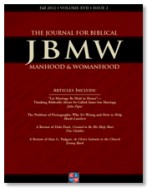
I am excited to announce that I have a new article that was just published in the Fall 2012 issue of the Journal for Biblical Manhood and Womanhood addressing the challenges that homosexuality creates for gender roles. I would like to thank Denny Burk and the editors at JBMW for including my article in this issue.
My article deals with the intersection of homosexuality and biblical gender roles. I make the argument that homosexuality is not compatible with gender roles as they appear in Scripture. By application, then, support for homosexuality requires a redefinition of gender roles. Here is a summary of my article from the introduction:
While much of the current debate has centered on gay rights and same-sex marriage, it is imperative to understand how the issue of homosexuality impacts a biblical understanding of gender roles. By its very nature of describing a relationship between two members of the same sex, homosexuality seems to make the question of gender roles irrelevant. Thus, there are vast challenges that homosexuality creates for a biblical discussion of gender roles. If believers are going to address these challenges both within the church and in the culture, they must first understand the impact that homosexuality has on a complementarian view of the sexes. Homosexuality denies the God-ordained nature of gender roles as revealed in Scripture by rejecting the complementary nature of sex, by subverting the complementary nature of marriage, and by distorting the complementary nature of the Christ-church relationship.
You can view and download the entire issue of the journal at the website of the Council on Biblical Manhood and Womanhood at www.cbmw.org.
There is an excellent article posted today on Public Discourse by Helen Alvare addressing the issues of government, religious liberty, and women’s health. Here are some of the highlights.
On the issue of the administration’s campaign targeting women:
The result is an administration—led by men, but fronted by women—blatantly in favor of the view that to be “for women” (and to be super cool), you should support casual sex and the free contraception that facilitates it. The Obama campaign’s real message about the HHS mandate translates as follows: If you object to coercing religious institutions into sponsoring free contraception, you are no friend to women.
On the threat to religious liberty:
Any American citizen or institution that visibly opposes this powerful alliance might realistically worry about its future. This is new for Christians in America. In decades past, only the most extremist abortion interest groups—e.g., Planned Parenthood and the National Abortion Rights Action League—visibly denounced the beliefs and practices of Christian churches regarding human sexuality, marriage, and family. But today, these groups command the prime-time podium at the Democratic National Convention, and count the president of the United States as their closest political ally.
On the challenge for Christians:
Instead, for the good of women and the good of society, Christians must engage in a hard conversation: what does women’s freedom truly include? Christian citizens, Catholics in particular, must explain why their witness on contraception contributes to, and doesn’t derogate, women’s long-term flourishing. These conversations must certainly deal with the world as it is—culturally, politically—but can never forget to speak of the world as it ought to be, the world parents hope to leave to their daughters and sons.
Christian churches need to be frank about what they are proposing concerning sex, parenting, and marriage. They shouldn’t hide the ball; that rightly infuriates people. And they should especially remember those people who often slip through the cracks, who are forgotten or ignored by the alliance of Planned Parenthood and the federal government: our poorest and least educated fellow citizens who suffer the most from the loss of a healthy marriage culture.
I’d like to encourage you to read the entire article. It appears that it will also include two more follow-up pieces in the days to come. You can find the article here.
During last week’s debate between Vice President Joe Biden and GOP Vice President nominee Paul Ryan, the moderator asked a very interesting question. Basing her question on the fact that both Biden and Ryan are Catholic, Martha Raddatz asked the candidates to explain how their faith impacts their politics, especially related to the issue of abortion. The answers were perhaps surprisingly similar in their foundation but vastly different in their application.
Congressman Ryan stated that he believed life begins at conception, which is in keeping with Catholic doctrine. He declared that he cannot separate his faith from his politics on the issue of abortion. Therefore, Ryan concluded that the policies of a Romney-Ryan administration would oppose abortion except in cases of rape and incest. It should be noted, however, that Ryan had stated previously his personal beliefs even oppose abortion in cases of rape and incest.
Vice President Biden offered a very similar response regarding the beginning of life. He acknowledged agreement that life begins at conception as a de fide doctrine of the Catholic Church. However, he went on to declare that he cannot force his morality on someone else and that a woman has the right to do as she wishes with her own body.
I doubt many people were shocked by the answers that Biden and Ryan offered. Some may have been surprised that Vice President Biden believes life begins at conception, and others may have been intrigued that Ryan did not espouse his personal views on abortion in cases of rape and incest. However, the general tenor of the answers held to firmly established party platforms for each candidate.
In the midst of this debate, I find it interesting that little evaluation has been offered of the inconsistency of Mr. Biden’s argument. There are two key elements of his answer that contradict many of his other political goals—absolute autonomy and the refusal to impose his own morality.
The argument for autonomy is common in the abortion debate. It generally takes the following form. A woman has the right to do with her body as she pleases. Her right to privacy and free choice trumps any other right. No one can tell her what she can and cannot do. Thus, a woman should have the right to have an abortion for any reason. This is the effect of the collective Supreme Court rulings of Roe v. Wade and Doe v. Bolton in 1973.
There is logical and political inconsistency in this position, however, for Mr. Biden. This argument is libertarian in nature and begs the question of complete autonomy in every aspect of life. For example, Mr. Biden (and pro-choice advocates in general) desire to see abortion on demand with no questions asked of the woman involved. She should be completely free to choose abortion for herself. Yet, there are a number of “choices” limited by government restrictions that contradict the logic of this argument. In most states, a young woman under the age of 18 cannot get a tattoo. Even if she has parental consent, states like California, Illinois, New Hampshire, New York, Rhode Island, Tennessee, Texas, and Washington make the tattooing of a minor a crime. In these states, parental consent cannot even trump the law to allow a minor to receive a tattoo.
By contrast, New York City is piloting a program in 13 of their public schools to make Plan B, the “morning-after pill,” available to young women without parental consent. Therefore, a fifteen-year-old girl cannot get a tattoo, but she can get an abortion-inducing drug. I ask the question, is she completely autonomous? Is the government telling her that she cannot do with her body as she chooses? Why does it apply to tattoos but not abortion?
This libertarian argument can be extended to several other areas that are restricted or outlawed by the government. You cannot buy a non-diet soda larger than 16 ounces in New York City. A host of drugs are illegal, not only to buy or sell but even to possess. Marriage laws forbid a person from marrying his/her siblings and first cousins. Government even restricts the number of people one can marry. In each of these cases, government has said that you are not free to do with your body as you wish. If Mr. Biden and other abortion rights advocates want to be consistent, they must disavow laws like these as well. However, I imagine that government officials could make a reasonable case for such laws to be on the books. Thus, their inconsistency is exposed.
The other part of Mr. Biden’s response relates to the idea that he is unwilling to impose his morality on someone else. This is egregiously inconsistent for anyone involved in government. The role of laws established by government is the imposition of morality on others. Laws that prohibit murder, theft, fraud, and slander impose someone’s morality on the rest of society. In fact all laws impose morality. For the argument of abortion rights advocates to be consistent, one has to accept moral anarchy. Everyone should be able to do what is right in his own eyes.
Abortion rights advocates claim that they do not want morality imposed on them, but they are willing accept the imposition of their own morality on others. The recent birth control mandate added to the Affordable Care Act (ObamaCare) imposes abortion rights morality on everyone by requiring that insurance companies supply birth control to all individuals covered at no charge to the patient. This mandate includes abortion-inducing drugs, such as Plan B and Ella. If abortion rights advocates are so opposed to the imposition of morality on others, they should oppose this mandate as well.
As seen in the examples above, the logic of abortion rights advocates in inconsistent. Without even considering the merit of their arguments, one can see that they are unable to apply their logic universally.
This is part 4 in an ongoing series where I answer the arguments of 22-year-old Harvard University student, Matthew Vines. In the previous three parts, I addressed his interpretation of Genesis 2 and Romans 1 and his claim that denying marriage to homosexuals inflicts undue pain. In this post, I consider his omission of Jesus’ teaching on the issue. Follow the links for Part 1, Part 2, and Part 3.
Throughout his argument, Matthew Vines attempts to contrast the supposedly legalistic teachings of the Old Testament and Paul with an ethic of love in the teachings of Jesus. His overall premise is that teaching cannot be good if it leads to “emotional and spiritual devastation” or “the loss of self-esteem and self-worth.” Vines claims that such concepts come from the teachings of Jesus, thus elevating the words of Jesus above any other teaching in Scripture.
He states:
Sacrifice and suffering were integral to the life of Christ, and as Christians, we’re called to deny ourselves, to take up our crosses, and to follow Him. This is true. But it assumes that there’s no doubt about the correctness of the traditional interpretation of Scripture on this subject, which I’m about to explore. And already, two major problems have presented themselves with that interpretation. The first problem is this: In Matthew 7, in the Sermon on the Mount, Jesus warns against false teachers, and he offers a principle that can be used to test good teaching from bad teaching. By their fruit, you will recognize them, he says. Every good tree bears good fruit, but a bad tree bears bad fruit. A good tree cannot bear bad fruit, and a bad tree cannot bear good fruit. Good teachings, according to Jesus, have good consequences. That doesn’t mean that following Christian teaching will or should be easy, and in fact, many of Jesus’s commands are not easy at all – turning the other cheek, loving your enemies, laying down your life for your friends. But those are all profound acts of love that both reflect God’s love for us and that powerfully affirm the dignity and worth of human life and of human beings. Good teachings, even when they are very difficult, are not destructive to human dignity. They don’t lead to emotional and spiritual devastation, and to the loss of self-esteem and self-worth. But those have been the consequences for gay people of the traditional teaching on homosexuality. It has not borne good fruit in their lives, and it’s caused them incalculable pain and suffering. If we’re taking Jesus seriously that bad fruit cannot come from a good tree, then that should cause us to question whether the traditional teaching is correct.
This line of argumentation suffers from a couple of problems. First, it diminishes the inspiration and authority of Scripture by subjecting the Word of God to an artificial hierarchy. Vines considers the words of Jesus to be more authoritative than the rest of Scripture. While Jesus was certainly God incarnate walking this earth and teaching his followers, the rest of Scripture is also from the mouth of God. Second Timothy 2:16–17 reads, “All Scripture is inspired by God and profitable for teaching, for reproof, for correction, for training in righteousness; so that the man of God may be adequate, equipped for every good work.” Thus, the words of Paul in Romans 1 are just as inspired as the Sermon on the Mount.
However, this is not the only problem with Vines’ arguments from the teachings of Jesus. Vines simply ignores Jesus’ teaching on marriage, which is devastating to his larger discussion. In Matthew 19:3–12, Jesus is confronted by the Pharisees about marriage. While their question addresses the issue of divorce, Jesus answers them with his interpretation of God’s design for marriage—one man and one woman for life. In verses 4–6, Jesus responds, “Have you not read that He who created them from the beginning made them male and female, and said, ‘For this reason a man shall leave his father and mother and be joined to his wife, and the two shall become one flesh’? So they are no longer two, but one flesh. What therefore God has joined together, let no man separate.” In this passage, Jesus affirms that God created male and female and that marriage is designed between one man and one woman. Those who say that Jesus never addressed the issue of same-sex marriage typically overlook this clear passage of Scripture. Biblical marriage and biblical sexuality are heterosexual in nature according to Jesus himself.
Based on his “love ethic,” Vines is missing a crucial part of Jesus’ teaching. Jesus declared that marriage is designed for one man and one woman. Even in his hierarchal hermeneutic, Vines must acknowledge Jesus’ words on this subject. Therefore, his condemnation of false teachers falls back on himself. Jesus made a clear statement about both gender and marriage. Any departure from that standard is a false teaching. Vines stands convicted by his own words on this issue.
It has been my hope in this series to provide reasonable answers to the arguments posed by Mr. Vines. Almost nothing about his argument is new; instead, he has repeated the same points that have been made by proponents of homosexuality for the last 40–50 years. While my counterpoints do not cover the entire scope of the discussion, I hope you can see that his logic is severely flawed.
This debate will most likely continue for years to come, especially in light of the push for legalizing same-sex marriage. I encourage you to study the Scriptures diligently and see how the consistent message of the Bible is that homosexuality is a sin. However, we must also remember that it is not the unpardonable sin. Paul declares, “Such were some of you; but you were sanctified, but you were justified in the name of the Lord Jesus Christ and in the Spirit of our God” (1 Cor 6:11). The key here is that some in the church at Corinth WERE homosexuals. They were redeemed by Christ, and he changed their lives. May we pray for the same for Mr. Vines and others struggling with this and any other sin.
This is part 3 in an ongoing series where I answer the arguments of 22-year-old Harvard University student, Matthew Vines. In the previous two parts, I addressed his interpretation of Genesis 2 and Romans 1. In this post, I consider his argument for same-sex marriage. Follow the links for Part 1 and Part 2.
As with most discussions regarding homosexuality, the focus eventually moves to the idea of same-sex marriage. As Mr. Vines has already noted in his argument (see part 1), he believes that homosexuals are commanded by God to join in loving, committed relationships. In addition, he believes such relationships should be recognized as marriage by both the church and the state. He also believes that denying marriage to same-sex couples inflicts undue pain on them, which is a violation of God’s command to love.
Vines presents his argument as follows:
Being different is no crime. Being gay is not a sin. And for a gay person to desire and pursue love and marriage and family is no more selfish or sinful than when a straight person desires and pursues the very same things. The Song of Songs tells us that King Solomon’s wedding day was “the day his heart rejoiced.” To deny to a small minority of people, not just a wedding day, but a lifetime of love and commitment and family is to inflict on them a devastating level of hurt and anguish. There is nothing in the Bible that indicates that Christians are called to perpetuate that kind of pain in other people’s lives rather than work to alleviate it, especially when the problem is so easy to fix. All it takes is acceptance. The Bible is not opposed to the acceptance of gay Christians, or to the possibility of loving relationships for them. And if you are uncomfortable with the idea of two men or two women in love, if you are dead-set against that idea, then I am asking you to try to see things differently for my sake, even if it makes you uncomfortable.
When Mr. Vines speaks of inflicting devastating pain and anguish on homosexuals by denying them the opportunity to marry, he is attempting to quantify pain and pleasure and determine if one outweighs the other. However, such attempts at moral calculus are inconsistent at best. Instead, we should evaluate whether or not homosexual relationships accomplish the goods of marriage according to Scripture. One of the goods of marriage in Scripture is unity (Gen 2:24). This is expressed through love, commitment, and the sexual bond. While one could make the argument that same-sex relationships accomplish this good, they only do so in violation of God’s standard for sexuality—sex between one man and one woman in the context of marriage for a lifetime. Since marriage is not commanded, proponents of same-sex marriage are actually attempting to accomplish a good at the expense of biblical sexuality. Therefore, the evil inflicted by active participation in sin actually undermines any good that could be accomplished in a loving, committed relationship. Mr. Vines, then, has transferred the blame for sin from those in violation of God’s command to those who are attempting to uphold the clear teaching of Scripture. The other goods of marriage from Scripture are also violated by homosexual couples. Genesis 1:28 proclaims procreation as a good of marriage, but that is biologically impossible for same-sex couples. The other good of marriage is sexual fidelity. While one might make an argument for fidelity in a committed same-sex relationship, the biblical concept of sexuality is between one man and one woman. We even see this in Jesus’ teaching in Matt 19:3-12.
I think Christians can always do better when addressing the issue of homosexuality. We need to remember that homosexuality is not the unpardonable sin. In 1 Cor 6:9-10, Paul gives a vice list with a number sins, including homosexuality. However, in verse 10 he states, “Such were some of you; but you were washed, but you were sanctified, but you were justified in the name of the Lord Jesus Christ and in the Spirit of our God.” It seems evident that there were former homosexuals in the church at Corinth. The key here is the idea “former.” Paul said, “Such were some of you.” It was in their past, but God had redeemed them from this sin. They had repented and were being sanctified. We need to focus on this.
The argument that Mr. Vines proposes typically leads to labels. The label most often attached to supporters of traditional marriage is hatred or hate speech. Even if we focus on the redemptive aspects of the biblical message and the former status of those in the church in Corinth, I suspect that Christians who oppose homosexuality will continue to be labeled as hateful. However, this is a misuse of the term. It is not hateful to disagree with someone’s position.
Proponents of homosexuality constantly call for tolerance. Unfortunately, their understanding of tolerance is one-sided. True tolerance acknowledges the existence of differing opinions, but it does not require agreement or acceptance. Mr. Vines calls for acceptance of his view while being intolerant of those who disagree. While he does not use the term “hatred,” the idea is present in his statement that proponents of traditional marriage “inflict . . . a devastating level of hurt and anguish.” Our entire culture could benefit from discussing the actual arguments rather than labeling people as hateful.


 Ethics as Worship