Polygamy: The Next Marriage Battle?

polygamyWhile the battle over same-sex marriage still rages, it is hard to imagine what the next battle might be. However, astute observers of the marriage debate have already seen the newest challenge to the definition of marriage—polygamy. In an article this week on Slate, Jillian Keenan proposes that the legalization of polygamous marriage is a desired result of the current marriage debate. She argues:

While the Supreme Court and the rest of us are all focused on the human right of marriage equality, let’s not forget that the fight doesn’t end with same-sex marriage. We need to legalize polygamy, too. Legalized polygamy in the United States is the constitutional, feminist, and sex-positive choice. More importantly, it would actually help protect, empower, and strengthen women, children, and families.

Keenan is not playing the “same-sex marriage is a slippery slope” card to argue against same-sex marriage. In fact, she ridicules that argument as a “tired refrain.” Instead, she brands herself as a feminist who believes polygamy is in the best interest of women and society and perfectly in keeping with the arguments for same-sex marriage.

Besides the 2011 lawsuit to decriminalize bigamy and polygamy in Utah filed by the stars of TLC’s Sister Wives, the discussion of polygamy and its connection to the same-sex marriage debate has been fairly silent. Keenan, however, wishes to end that silence.

While admitting that the argument against polygamy has generally been that it hurts women and children, Keenan believes legalization would actually benefit them. She claims that polygamists live in the shadows and fear the authorities. If they were allowed to live in the open, they would be more likely to report instances of abuse.

In addition, she believes feminists should support polygamy because it empowers women. She states:

Finally, prohibiting polygamy on “feminist” grounds—that these marriages are inherently degrading to the women involved—is misguided. The case for polygamy is, in fact, a feminist one and shows women the respect we deserve. Here’s the thing: As women, we really can make our own choices. We just might choose things people don’t like. If a woman wants to marry a man, that’s great. If she wants to marry another woman, that’s great too. If she wants to marry a hipster, well—I suppose that’s the price of freedom.

And if she wants to marry a man with three other wives, that’s her . . . choice.

At the end of her article, she gets down to the fundamental argument for why polygamy ought to be legalized. On this point, her logic is sound—I just disagree with her first premise. She declares:

The definition of marriage is plastic. Just like heterosexual marriage is no better or worse than homosexual marriage, marriage between two consenting adults is not inherently more or less “correct” than marriage among three (or four, or six) consenting adults. Though polygamists are a minority—a tiny minority, in fact—freedom has no value unless it extends to even the smallest and most marginalized groups among us. So let’s fight for marriage equality until it extends to every same-sex couple in the United States—and then let’s keep fighting. We’re not done yet.

Keenan’s entire argument is built upon the idea that the definition of marriage is plastic. She believes it is constantly changing and must always expand to include the newest idea.

This is the clear connection to the same-sex marriage debate.

The current battle over marriage involves the definition of marriage. Proponents of same-sex marriage (and supporters of polygamy) consider marriage to be an intimate, emotional relationship between individuals. They offer no basis for discrimination according to gender or number. Thus, the “new” definition of marriage would allow for same-sex marriage and polygamy. If culture, and specifically the government, adopts this new definition of marriage, then Keenan is right. There will be no choice but to legalize polygamy as well as same-sex marriage. However, Keenan does not go far enough. Incest is the next step of progression. We could add to her argument above: “If a woman wants to marry a man, that’s great. If she wants to marry another woman, that’s great too. If she wants to marry a hipster, well—I suppose that’s the price of freedom.” The next line should read: “If she even wants to marry her brother, that’s her choice.”

This is the direction of the debate. Keenan has opened the door and publicly stated what others have been ridiculed for saying. The definition of marriage matters. A redefinition of marriage will undermine the entire concept of marriage that has been recognized throughout human history. As Chief Justice John Roberts stated during the oral arguments before the Supreme Court: “If you tell a child that somebody has to be their friend, I suppose you can force the child to say, ‘This is my friend.’ But it changes the definition of what it means to be a friend.” If we tell people they can marry whomever they wish no matter the gender, number, or blood relationship, I suppose we could call that marriage. However, it changes the definition of what it means to be married.

_________________________

Jillian Keenan, “Legalize Polygamy! No. I am not kidding.” Slate, April 15, 2013.

Federal Judge Requires Non-Prescription Access to Morning-After Pill in a Month

UltrasoundU.S. District Judge Edward Korman (Eastern District of New York) has ruled that the FDA must make the multiple versions of the morning-after pill available over-the-counter without a prescription and without age restrictions within one month. The FDA had previously decided to make the morning-after pill available to girls younger that 17, but Health and Human Services Secretary Kathleen Sebellius overruled the FDA in 2011, setting the age restriction of 17 or older.

The court decision comes as a result of a lawsuit filed by the Center for Reproductive Rights. According to CNN, Nancy Northrup, president and CEO of the Center for Reproductive Rights, responded to the decision by saying, “Today science has finally prevailed over politics. This landmark court decision has struck a huge blow to the deep-seated discrimination that has for too long denied women access to a full range of safe and effective birth control methods.”

I actually believe Northrup has it wrong. Politics has prevailed in this instance to the detriment of girls and young women across the country. Since the sexual revolution, there has been a movement to separate sexual activity from marriage. The goal has been to make sexual expression the epitome of freedom. Instead, girls and young women are going to find themselves shackled with more emotional baggage and more sexually transmitted diseases. In addition, girls may experience “coerced” or even “forced” use of the morning-after pill by boyfriends, casual partners, or even parents wishing to “limit the damage” from their sexual expression. This is not freedom–it is bondage to culture.

Judge Korman even makes an interesting remark toward Sebellius and the FDA in his judgment. He states:

The FDA has engaged in intolerable delays in processing the petition. Indeed, it could accurately be described as an administrative agency filibuster. Moreover, one of the devices the FDA has employed to stall proceedings was to seek public comment on whether or not it needed to engage in rulemaking in order to adopt an age-restricted marketing regime. After eating up eleven months, 47,000 public comments, and hundreds of thousands, if not millions, of dollars, it decided that it did not need rulemaking after all. The plaintiffs should not be forced to endure, nor should the agency’s misconduct be rewarded by, an exercise that permits the FDA to engage in further delay and obstruction.

Does Judge Korman not believe that the FDA may have actually been seeking the well-being of young girls? His commentary in the court order is chilling. The fact that the FDA was seeking public comment and input on whether or not this was good for 10-16 year old girls is a good thing. However, Korman views it as agency misconduct.

From the outset of creation, God has declared that the sexual relationship is properly expressed only within marriage. This is one way in which marriage is ordered to procreation. The vast majority of individuals seeking the use of these abortion-inducing drugs will not be married adults. They will instead be young people pursuing unhindered sexual freedom who suddenly find themselves shackled by the consequences of their behavior. When you add the category of girls who will be coerced into taking these drugs by those who “love” them, the damage becomes overwhelming.

This decision further undermines the institution of marriage and elevates abortion to the status of relieving a headache with Tylenol. This is a sad commentary on the culture of the “New America.”

_________________________

Edward Korman, Tumino vs. Hamburg, U.S. District Court, Eastern District of New York, April 4, 2013.

Judges orders morning-after pill available without prescription,” CNN, April 5, 2013.

Federal judge rules morning-after pill must be available for women of all ages,” Fox News, April 5, 2013.

For more information about the impact of the sexual culture on young women, pick up a copy of Girls Uncovered: New Research on What America’s Sexual Culture Does to Young Women by Joe S. McIlhaney, Jr., and Freda McKissic Bush.

The Associated Press and the Normalization of Same-Sex Marriage

Last week the Associated Press (AP) notified its constituents of a new entry in the AP Stylebook. This new entry addresses the appropriate use of the terms husband and wife. The text of the entry is:

husband, wife Regardless of sexual orientation, husband or wife is acceptable in all references to individuals in any legally recognized marriage. Spouse or partner may be used if requested.

This entry has been officially added to the online version of the AP Stylebook and will appear in the print edition later this spring.

The Associated Press is perhaps the most influential news organization in the world. Their stories and photos have run in news outlets since 1846. The AP Stylebook (first published in 1953 and updated annually) serves as the standard style guide for journalists. As a result, the choices the Stylebook makes in the use of language impact how readers and listeners of news media will view issues.

In a press release on the new Stylebook entry, Mike Oreskes, AP Senior Managing Editor for U.S. News, stated,

The AP has never had a Stylebook entry on the question of the usage of husband and wife. All the previous conversation was in the absence of such a formal entry. This lays down clear and simple usage. After reviewing existing practice, we are formalizing ‘husband, wife’ as an entry.

I find the comment by Mr. Oreskes to be quite interesting. For 50 years, the Associated Press had never seen a reason to post an entry regarding the usage of husband and wife. However, now they determine there is a need for such an entry, and it reflects a change to the long held understanding of marriage in our society. I would argue that the reason no entry was needed previously is that society at large clearly understood the meaning and usage of husband and wife. A husband and wife are the two individuals in a marriage. The husband is male, and the wife is female. It was understood that a husband would have a wife and a wife would have a husband.

However, in this age of attempts to redefine marriage, the AP has determined it will weigh in on the matter. Notice the language of the entry. It reads, “Regardless of sexual orientation, husband or wife is acceptable in all references to individuals in any legally recognized marriage.” Thus, journalists can use AP-approved style to refer to two husbands or two wives. They could, perhaps, even refer to the two individuals in a same-sex marriage as husband and wife with the approval of the couple if that is how the individuals view their roles in that “marriage.”

The AP has jumped into the fray with an agenda to normalize same-sex marriage in society through the use of language in journalism. What I find ironic in all of this is the tag at the end of the press release describing the AP. It reads:

The Associated Press is the essential global news network, delivering fast, unbiased news from every corner of the world to all media platforms and formats. Founded in 1846, AP today is the most trusted source of independent news and information. On any given day, more than half the world’s population sees news from AP. On the Web: www.ap.org.

There are a few adjectives that the AP uses to describe itself that are violated in their latest addition to the Stylebook. They claim to be a “global news network,” to deliver “unbiased news,” and to be a “trusted source of independent news and information.”

As a “global news network,” surely the AP is aware that same-sex marriage is not a global norm. In fact, most of the world does not recognize same-sex marriage as legitimate. Delivering “unbiased news” means that it is free of political agendas, yet there is hardly a more vocal political group than the homosexual community attempting to normalize their lifestyle. Finally, a “trusted source of independent news and information” will refrain from promoting a particular viewpoint over other valid options. In making this change to the Stylebook, the Associated Press has violated all three of these descriptions for its own mission.

The normalization of same-sex marriage (and homosexuality in general) has been a goal of the homosexual community for decades. They have often found a sympathetic ear among journalists, especially those whose politics lean to the left. However, they have now found support from the “essential global news network” known as the Associated Press. Despite the fact that the AP claims to be unbiased and independent, it has now voiced an opinion in this matter. The opinion was placed in the most subtle of places—a journalistic style manual. I dare say this was not by accident. Why make a public policy statement when you can simply change the use of language?

In Matthew 10:16, Jesus told his disciples, “Behold, I send you out as sheep in the midst of wolves; so be shrewd as serpents and innocent as doves.” As Christians, we tend to do fairly well on being “innocent as doves,” but we often lack the shrewdness of serpents. This is a time when we need to be shrewd and attentive to our culture so that we are prepared to defend the biblical model of marriage as it is being attacked on all sides.

_________________________

New entry in the AP Stylebook: husband, wife,” Associated Press, February 21, 2013.

*Special thanks to Benjamin Hawkins, Senior Writer in the Office of Communications at Southwestern Baptist Theological Seminary, for bring this announcement to my attention.

Use of “Morning-After Pill” on the Rise

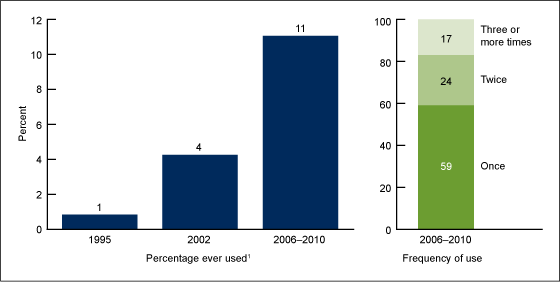
Percentage of sexually experienced women aged 15–44 who have ever used emergency contraception: United States, 1995, 2002, and 2006–2010, and frequency of use among women who have ever used emergency contraception, 2006–2010. SOURCES: CDC/NCHS, National Survey of Family Growth, 1995, 2002, and 2006–2010.

The Centers for Disease Control and Prevention released a report last week that flew under the radar of most news organizations. They conducted a five-year study (2006–2010) on the use of the “morning-after pill” (labeled “emergency contraception” in the study—more on that later) and found that 11% of “sexually experienced women aged 15–44 . . . had used emergency contraception, up from 4.2% in 2002.” Thus, in less than ten years, use of this form of birth control has almost tripled.

Other facts released in the study include:

  • Most women who had ever used emergency contraception had done so once (59%) or twice (24%).
  • Young adult women aged 20–24 were most likely to have ever used emergency contraception; about one in four had done so (23%).
  • Almost 1 in 5 never-married women (19%), 1 in 7 cohabiting women (14%), and 1 in 20 currently or formerly married women (5.7%) had ever used emergency contraception.
  • Non-Hispanic white and Hispanic women were more likely to have ever used emergency contraception (11%) compared with non-Hispanic black women (7.9%).
  • Ever-use of emergency contraception increased with educational attainment—12% of women with a bachelor’s degree or higher and 11% of women with some college education had ever used it. This compares with 7.1% of women who had a high school diploma or GED and 5.5% of women with less than a high school education.

We can make a few key observations from this report. First, emergency birth control is on the rise. As this method of eliminating an unplanned pregnancy has become more normalized, the rates of use have gone up significantly.

Second, the use of emergency birth control is especially high in women in their 20’s. As the median age of first marriage gets older (28.7 for men and 26.5 for women as of 2011), the number of unmarried women having a sexual relationship increases. Most of those desire to avoid pregnancy and opt for emergency solutions when other methods fail or are not employed. This trend is likely to continue as marriage and children become less of a norm.

Third, education seems to increase the likelihood of using emergency birth control even though it also increases the likelihood of marriage. Despite the fact that married women are less likely to use the morning-after pill and women with more education tend to get married, the two trends do not track together. It is possible that those with more education using the emergency birth control are moving towards marriage but have not yet arrived at that stage.

So what should we make of this? Does this represent the demise of family and biblical sexuality in American culture? Should the church even be concerned?

In short, the church should be concerned on a few different levels. This issue is not going away any time soon, so we need to be prepared to address it. Let me note a few items for us to consider.

The first issue is a terminology problem. As evidenced in the report, the morning-after pill is labeled as emergency contraception. However, this is inaccurate. Contraception, by its very definition, is something that prevents conception. Plan B, Ella, and other forms of this pill are intended to prevent pregnancy after intercourse; thus, taking into account that fertilization may have already occurred. Therefore, they should be called birth control (preventing birth) rather than contraception.

The second issue is a life problem. The CDC report notes, “Emergency contraception can be used by women after sexual intercourse in an effort to prevent an unintended pregnancy. Roughly one-half of all pregnancies in the United States are unintended.” Intended or unintended, pregnancies represent lives. Innocent human life in the form of a developing baby in the womb is that which is eliminated by emergency birth control. Those who are in favor of protecting unborn life should stand in opposition to the proliferation of these drugs. Unfortunately, our culture views children more as commodities than lives. They are financial investments and burdens rather than blessings (Psalm 127:3–5). We need to return to a biblical perspective on children and life in the womb.

The third problem is the lack of information in the church. Birth control is one of those issues we just don’t talk about. However, nearly a quarter of the women aged 20–24 in the survey had used emergency birth control. It’s a tough issue. You are talking about life, reproduction, medical decisions, and other aspects of the private lives of women all at the same time. Just because it is difficult, though, does not mean we should avoid it. My guess is that many of these women represent churches all across the United States. In fact, there are probably women scattered throughout Southern Baptist congregations who have used this form of birth control.

We need to talk about it. We need to inform our people. We need to protect life. In and of itself, it may not represent the demise of marriage and family in culture, but it certainly speaks to a trajectory we are currently on.

_________________________

Kimberly Daniels, Jo Jones, and Joyce Abma, “Use of Emergency Contraception Among Women Aged 15–44: United States, 2006–2010,” Centers for Disease Control and Prevention, February 2013.

What Did Jesus Teach About Homosexuality?: Answering Matthew Vines Part 4

This is part 4 in an ongoing series where I answer the arguments of 22-year-old Harvard University student, Matthew Vines. In the previous three parts, I addressed his interpretation of Genesis 2 and Romans 1 and his claim that denying marriage to homosexuals inflicts undue pain. In this post, I consider his omission of Jesus’ teaching on the issue. Follow the links for Part 1, Part 2, and Part 3.

Throughout his argument, Matthew Vines attempts to contrast the supposedly legalistic teachings of the Old Testament and Paul with an ethic of love in the teachings of Jesus. His overall premise is that teaching cannot be good if it leads to “emotional and spiritual devastation” or “the loss of self-esteem and self-worth.” Vines claims that such concepts come from the teachings of Jesus, thus elevating the words of Jesus above any other teaching in Scripture.

He states:

Sacrifice and suffering were integral to the life of Christ, and as Christians, we’re called to deny ourselves, to take up our crosses, and to follow Him. This is true. But it assumes that there’s no doubt about the correctness of the traditional interpretation of Scripture on this subject, which I’m about to explore. And already, two major problems have presented themselves with that interpretation. The first problem is this: In Matthew 7, in the Sermon on the Mount, Jesus warns against false teachers, and he offers a principle that can be used to test good teaching from bad teaching. By their fruit, you will recognize them, he says. Every good tree bears good fruit, but a bad tree bears bad fruit. A good tree cannot bear bad fruit, and a bad tree cannot bear good fruit. Good teachings, according to Jesus, have good consequences. That doesn’t mean that following Christian teaching will or should be easy, and in fact, many of Jesus’s commands are not easy at all – turning the other cheek, loving your enemies, laying down your life for your friends. But those are all profound acts of love that both reflect God’s love for us and that powerfully affirm the dignity and worth of human life and of human beings. Good teachings, even when they are very difficult, are not destructive to human dignity. They don’t lead to emotional and spiritual devastation, and to the loss of self-esteem and self-worth. But those have been the consequences for gay people of the traditional teaching on homosexuality. It has not borne good fruit in their lives, and it’s caused them incalculable pain and suffering. If we’re taking Jesus seriously that bad fruit cannot come from a good tree, then that should cause us to question whether the traditional teaching is correct.

This line of argumentation suffers from a couple of problems. First, it diminishes the inspiration and authority of Scripture by subjecting the Word of God to an artificial hierarchy. Vines considers the words of Jesus to be more authoritative than the rest of Scripture. While Jesus was certainly God incarnate walking this earth and teaching his followers, the rest of Scripture is also from the mouth of God. Second Timothy 2:16–17 reads, “All Scripture is inspired by God and profitable for teaching, for reproof, for correction, for training in righteousness; so that the man of God may be adequate, equipped for every good work.” Thus, the words of Paul in Romans 1 are just as inspired as the Sermon on the Mount.

However, this is not the only problem with Vines’ arguments from the teachings of Jesus. Vines simply ignores Jesus’ teaching on marriage, which is devastating to his larger discussion. In Matthew 19:3–12, Jesus is confronted by the Pharisees about marriage. While their question addresses the issue of divorce, Jesus answers them with his interpretation of God’s design for marriage—one man and one woman for life. In verses 4–6, Jesus responds, “Have you not read that He who created them from the beginning made them male and female, and said, ‘For this reason a man shall leave his father and mother and be joined to his wife, and the two shall become one flesh’? So they are no longer two, but one flesh. What therefore God has joined together, let no man separate.” In this passage, Jesus affirms that God created male and female and that marriage is designed between one man and one woman. Those who say that Jesus never addressed the issue of same-sex marriage typically overlook this clear passage of Scripture. Biblical marriage and biblical sexuality are heterosexual in nature according to Jesus himself.

Based on his “love ethic,” Vines is missing a crucial part of Jesus’ teaching. Jesus declared that marriage is designed for one man and one woman. Even in his hierarchal hermeneutic, Vines must acknowledge Jesus’ words on this subject. Therefore, his condemnation of false teachers falls back on himself. Jesus made a clear statement about both gender and marriage. Any departure from that standard is a false teaching. Vines stands convicted by his own words on this issue.

It has been my hope in this series to provide reasonable answers to the arguments posed by Mr. Vines. Almost nothing about his argument is new; instead, he has repeated the same points that have been made by proponents of homosexuality for the last 40–50 years. While my counterpoints do not cover the entire scope of the discussion, I hope you can see that his logic is severely flawed.

This debate will most likely continue for years to come, especially in light of the push for legalizing same-sex marriage. I encourage you to study the Scriptures diligently and see how the consistent message of the Bible is that homosexuality is a sin. However, we must also remember that it is not the unpardonable sin. Paul declares, “Such were some of you; but you were sanctified, but you were justified in the name of the Lord Jesus Christ and in the Spirit of our God” (1 Cor 6:11). The key here is that some in the church at Corinth WERE homosexuals. They were redeemed by Christ, and he changed their lives. May we pray for the same for Mr. Vines and others struggling with this and any other sin.

_________________________

For the full text of article on The Christian Post, see Lillian Kwon, “Theologians Find Vines’ ‘Homosexuality Is Not a Sin’ Thesis Not Persuasive,” The Christian Post, September 28, 2012.

For the full text of Matthew Vines’ defense of homosexuality, see Matthew Vines, “The Gay Debate: The Bible and Homosexuality,” http://matthewvines.com.