“We Believe…”: Changing Your Church Constitution and By-Laws

wedding ringsWe are all theologians in a sense. Not everyone has pursued formal theological education to attain a degree that gives “theologian credentials,” but we all have at least some basic belief about God, man, sin, and salvation (or the lack thereof). When new churches start, they often spend countless hours laboring over how to express their theological beliefs in a written statement so that prospective members will know exactly what kind of church they are joining. In a perfect world, such statements of belief will find their way into the constitution or by-laws as the articles of faith or statement of belief.

For the most part, a church’s articles of faith will lay out the basic beliefs of the church regarding the Bible, God, Christ, man, sin, salvation, the church, ordinances and office, membership, and perhaps a handful of other things. This raises the question of marriage, sexuality, and gender identity—where do they fit in a statement of belief? Do they even belong in the first place?

Within a classical understanding of doctrine, a statement regarding marriage, sexuality, and gender identity could fit easily under the category of anthropology. The doctrine of anthropology is the study of human nature and existence. This doctrine asks the questions: Who am I? How did I get here? What is my purpose in life?

The best place to start in answering those questions is the first chapters of Genesis. Here we see some key truths about human nature that we must not forget. First, we are created by God—that is how we got here (Gen 1:26–27). Next, we are created in God’s image (Gen 1:26–27). While the image of God includes a number of different aspects, we can at least affirm that it includes the fact that we are created for a relationship with God. Third, we have been given stewardship over the rest of creation (Gen 1:26, 28), which means that we have the unique responsibility of caring for everything else God has made. Fourth, we see that God created us in two distinct genders—male and female (Gen 1:27). And finally, we recognize that God intended for the man and woman to “be fruitful and multiply, and fill the earth” (Gen 1:28). These points will become very important as we see below.

When we move to Genesis 2, we learn about how mankind is created to relate to one another. In verse 18 we read, “Then the Lord God said, ‘It is not good for the man to be alone; I will make him a helper suitable for him.’” In the verses that follow, we see the creation of the woman and the first marriage. God takes one of Adam’s ribs and fashions the woman out of it (Gen 2:21–22). He then brings the woman to Adam and presents her to him as his “suitable partner,” or his wife. In verse 23, we read Adam’s response to God granting recognition that this woman is “bone of my bones, and flesh of my flesh.” Finally, verse 24 gives us the divinely inspired commentary on this union. We read, “For this reason a man shall leave his father and his mother, and be joined to his wife; and they shall become one flesh.”

What we learn from the creation narrative is that marriage is a comprehensive union of a man and a woman in an exclusive, monogamous, covenant relationship designed to endure for a lifetime and directed toward the rearing of the next generation.

Not only do the opening chapters of Genesis point out God’s design for marriage, but they also lay the foundation for our understanding of gender and sexual identity. Note that God created two genders—male and female. He did not create the multiplicity of genders or sexual identities in the ever-expanding LGBTQ nomenclature. There are simply male and female, and they are designed to be complementary partners to one another. This is most clearly expressed through the institution of marriage.

Marriage between a man and a woman then becomes the only biblically authorized context for sexual expression. Any sexual expression apart from an exclusive, monogamous marriage between one man and one woman is sinful according to the text of Scripture.

It is this understanding that we want to put into the governing documents of our churches. Thankfully, we do not need to re-create the wheel in order to get an effective statement on anthropology, marriage, and sexuality into our church constitutions and by-laws. The first place that you ought to look is the statement of faith of your own denomination. Many denominations have such statements that will give you a starting point for appropriate language to use. The statement of your denomination might not be comprehensive enough for what we face today, but it should a good place to start. You can add to those denominational resources the helpful input of groups like Alliance Defending Freedom who have composed language that could be adopted into your constitution. Their work is more generic in order to appeal across denominational lines. My preference is to combine both such resources to develop a unique statement that addresses the needs of your specific church and the distinctive of your faith tradition. For example, below is my proposed statement that I believe works well within a Southern Baptist context.

We believe that God has created humans in his image and in the two distinct and complementary genders of male and female. These two genders are expressed in both physical biology and roles. Any departure from the biblical standard of male and female, whether that be a rejection of biological gender or an attempt to alter biological gender, is a violation of Scripture. (Gen 1:26–27; Matt 19:4; Mark 10:6; Eph 5:21–33)

We believe that marriage is the uniting of one man and one woman in an exclusive, monogamous, covenant commitment for a lifetime. It is God’s unique gift to reveal the union between Christ and his church and to provide for the man and the woman in marriage the framework for intimate companionship, the channel of sexual expression according to biblical standards, and the means for procreation of the human race. (Gen 1:26–28; 2:18–24; Prov 14:1; 17:6; 18:22; 31:10–31; Eccl 9:9; Matt 19:3–9; Mark 10:6–12; 1 Cor 7:1–16; Eph 5:21–6:4; Col 3:18–21; 1 Tim 5:14; 1 Pet 3:1–7)

We believe that any form of sexual immorality (including adultery, fornication, homosexuality, bisexuality, bestiality, incest, and pornography) is sinful and offensive to God. (Exod 20:14; Lev 18:6–23; 20:10–21; Job 31:1; Prov 5:1–20; Matt 5:27–28; Mark 7: 10–23; Rom 1:26–27; 1 Cor 6:9–20; 7:1–5; Gal 5:19–21; Eph 5:3–5; Col 3:5; 1 Thes 4:3–5; Heb 13:4; Jude 7)

We believe that God offers redemption and restoration to all who confess and forsake their sin, seeking His mercy and forgiveness through Jesus Christ. (John 14:6; Rom 3:23; 6:23; 1 Cor 6:11; 1 John 1:9)

We believe that every person must be afforded compassion, love, kindness, respect, and dignity. Hateful and harassing behavior or attitudes directed toward any individual are to be repudiated and are not in accord with scripture nor the doctrines of the church. However, identifying particular behaviors and identities as sin does not constitute harassment or hate. (1 Cor 13:1–13; Gal 6:1; Eph 4:15, 32; James 1:19)*

Let me suggest that you work on your own statement of beliefs in the area of marriage, sexuality, and gender so that your church can have a clear position on the issue. You may use the one provided above or adapt it for your own purposes. Remember, the purpose of such a statement is to state clearly what you believe about marriage, sexuality, and gender.

_________________________

*Much of this statement has been adapted and/or copied from Article XVIII of the Baptist Faith & Message (2000) and “Five Things All Churches Should Have in Their Bylaws” from Alliance Defending Freedom. Both of these resources are available to the public at the links above.

This is the second installment of a multi-part series addressing why churches need to consider updating their organizational documents. The series is written in conjunction with Dr. Waylan Owens. Part 1 is available here.

Disclaimer: This series of posts is not intended to provide legal advice regarding church law, membership issues, or lawsuits. While the posts have implications for potential legal matters, we suggest you consult an attorney for answers to any legal questions related to the subject matter of these posts.

There’s No Time Like the Present: Changing Your Church Constitution and By-Laws

wedding ringsThe state of marriage, gender, and sexuality is changing right before our very eyes. The prospects of same-sex marriage, fluid gender self-identification, and acceptance of a plethora of sexual expressions outside of heterosexual monogamous marriage were unfathomable within evangelical circles just 25 years ago. But times are changing.

Same-sex marriage is now at least partially legalized in 38 states, and 20 of those states have been added to the list since May 2014. The Supreme Court is expected to hear oral arguments on the constitutionality of same-sex marriage across the country this spring and issue a decision in the summer.

States and municipalities have passed legislation making it illegal to discriminate on the basis of sexuality or gender identity. In Houston such an ordinance led to a request by the mayor to subpoena manuscripts of sermons from pastors when they preached about sexuality.

While the application of these laws and ordinances to churches have been rebuffed by the courts so far, the day is likely coming when motivated and well-funded activists will attempt to sue churches for disallowing membership, refusing to host a wedding, or actively taking a stand on issues related to sexuality and gender identification. I am still confident that any lawsuits ultimately will be dismissed by the courts on the basis of the First Amendment; however, there are steps that we can take to ensure those lawsuits are dismissed promptly.

In addition, many evangelicals who support traditional marriage are probably satisfied with the stances of our pastors, ministerial staff, and congregations on the matter. Yet, there could come a time when a pastor, minister, or church member changes his viewpoint and desires to effect change in the church. What would that do to the historic position of the church? What would change look like? What would we do in such a situation?

These are the questions that prompted this series of posts related to church constitutions and by-laws. This is the first of several posts that will delve into why churches need to consider updates to their organizational documents in the area of sexuality and gender identity. It is an area much broader than homosexuality versus heterosexuality. In fact, our goal is not so much to exclude certain behaviors and identities from the church so much as it is to state clearly what we believe in these areas.

I understand that talking about constitutions and by-laws is not the most exciting conversation. I also recognize that many churches have not updated them in decades—if ever. Yet, this is a crucial area of church governance that can serve us well in the midst of difficult days.

The goal of updating a church’s organizational documents is not necessarily to create another step in the membership or hiring processes. Instead, the goal is to affirm what we believe from a positive standpoint while the culture attempts to steer us in a different direction.

With that being said, I believe there is no time like the present to do a thorough review of your organizational documents and make the necessary changes to protect the church from legal action and to protect the integrity of the church from biblical and theological drifting. Change isn’t always fun, but in this situation it is necessary.

Working in conjunction with Waylan Owens, Dean of the Terry School for Church and Family Ministries and longtime pastor of churches in Mississippi, Alaska, and North Carolina, we will endeavor to offer some food for thought and resources for churches that can be useful for standing for truth in a world that calls us to acquiesce. Our suggestions are not intended to be exhaustive but rather instructive as to what you can do to help your church navigate the waters of these changing times.

_________________________

This multi-part series will be posted on this blog and the blog of Waylan Owens. We have worked together on this series to bring together our unique skill sets and experience.

Links for other posts in the series: Part 2, Part 3, Part 4.

Disclaimer: This series of posts is not intended to provide legal advice regarding church law, membership issues, or lawsuits. While the posts have implications for potential legal matters, we suggest you consult an attorney for answers to any legal questions related to the subject matter of these posts.

Football and Family Dynamics

When I was a kid, I wanted to play professional football. I was an avid Chicago Bears fan, and I remember asking my parents to tape Super Bowl XX on our VCR. I wanted to see what the vaunted Bears defense would do to the hated Patriots (a hatred I still carry to this day). I wanted to see if William “Refrigerator” Perry would score a touchdown. I wanted to watch Walter Payton run for days in the big game. I probably even knew the words to the “Super Bowl Shuffle.” In fact, in first grade I remember writing one of those “What do you want to be when you grow up?” assignments and said that I wanted to play middle linebacker for the Bears like Mike Singletary. As the years went by, my athletic skills did not develop, nor did my body type fit the prototypical NFL middle linebacker. Oh well.
Even though my life and skills never matched the level necessary to rise to the ranks of NFL superstar, one aspect of my life does fit the mold—an intact family.

This week, ESPN released the results of a survey they conducted with 128 current and former NFL quarterbacks. Some of those surveyed include Super Bowl winners Peyton Manning, Eli Manning, Joe Flacco, and Russell Wilson. Among the retired quarterbacks surveyed were Hall of Famers Joe Namath, Bob Griese, and Steve Young.

Some of the questions included in the survey considered typical football-related topics, such as when they first threw a football, if they played in a spread offense in high school, and if they attended an instructional camp to develop skills or be seen by scouts. But the most interesting results to me were the ones about their families.

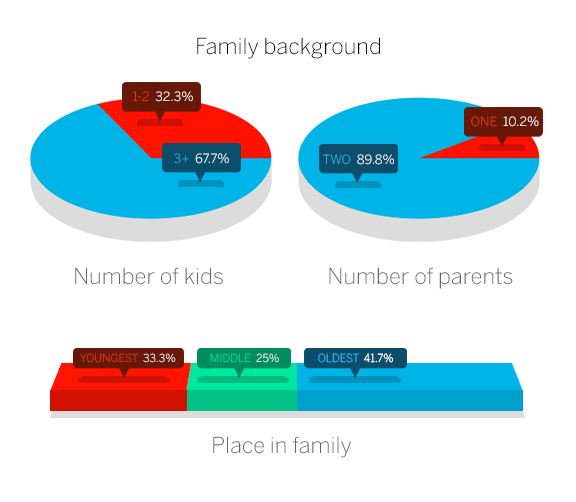
Nearly 90% of the quarterbacks surveyed came from 2-parent households!

In addition, over two-thirds of them came from families of 3 or more children. Thus, it seems that the typical NFL quarterback (including some of the best of all time) comes from what would be considered a larger family with both parents. ESPN reports:

[A]ccording to the Child Trends Databank, ‘the number and type of parents (e.g. biological, step) in the household, as well as the relationship between the parents, are strongly linked to a child’s well-being.’ Our survey did not seek details beyond the number of parents in the household, but the overwhelming presence of two parents (nearly 90 percent) in quarterback homes outpaced the overall nation average.

NFL quarterbacks seem to be passing over the top of all the cultural trends. Almost 41% of all children born in the United States today are born to unwed mothers. 37% of families with children under 18 do not include married parents.

In addition, the typical American family has less than two children today, but the typical quarterback comes from a family with 3 or more children. Perhaps one could see this as an advantage to have more receivers to throw the ball to and more defenders to allow him to practice avoiding the rush. No matter how you look at it though, the successful quarterback at the highest level of football comes from a family that is no longer normal in the United States. Instead, they come from traditional married families with more than the average number of children.

I can’t tell you how many parents are convinced that their kids are going to play professional sports when they get older. Some have even limited the size of their families in order to pour their energy and resources into giving a child or two that special opportunity. Some might even be willing to sacrifice their marriages in order for a child to hit that big payday in the NFL. But it seems from this research that the best place to start a pro career is by throwing the ball to your brothers and sisters in the yard while your mom and dad lovingly look on.

_________________________

Kevin Seifert, “Quarterback survey: What we learned,” ESPN.com, February, 4, 2015.

Centers for Disease Control and Prevention, “Unmarried Childbearing,” CDC.gov.

Jonathan Vespa, Jamie M. Lewis, and Rose M. Kreider, “America’s Families and Living Arrangements: 2012,” U.S. Census Bureau, August 2013.

U.S. Census Bureau, “Average number of own children per family (for families with own children under 18),” Census.gov.

Image credit: Jeffrey Beall, Flickr

Supreme Court to Decide Constitutionality of Same-Sex Marriage Laws

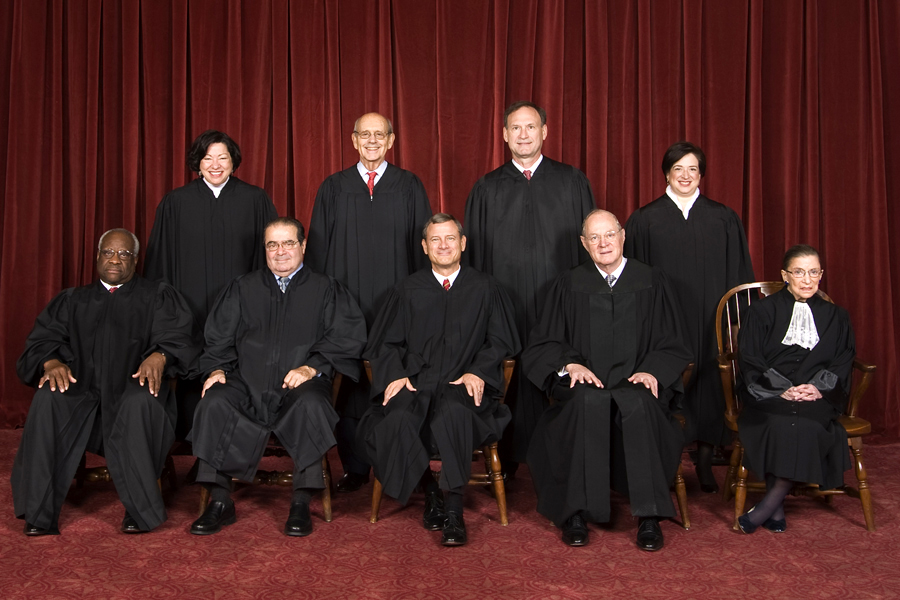
Supreme_Court_US_2010The Supreme Court has just announced that it will hear four cases involving the constitutionality of same-sex marriage laws around the United States. The hearings will most likely be in April with a decision in June.

Two central questions will be considered according to the Court’s statement granting certiorari:

  1. Does the Fourteenth Amendment require a state to license a marriage between two people of the same sex?
  2. Does the Fourteenth Amendment require a state to recognize a marriage between two people of the same sex when their marriage was lawfully licensed and performed out-of-state?

The answers to these questions will decide the future of marriage across the United States. If the answer to the first question is “Yes,” then same-sex marriage will be legalized nationwide, and the second question would be irrelevant. If the answer to the first question is “No,” but the second question is answered “Yes,” then it will authorize de facto same-sex marriage across the country. If both questions are answered “No,” then the status quo will continue.

The New York Times notes:

The pace of change on same-sex marriage, in both popular opinion and in the courts, has no parallel in the nation’s history.

Based on the court’s failure to act in October and its last three major gay rights rulings, most observers expect the court to establish a nationwide constitutional right to same-sex marriage. But the court also has a history of caution in this area.

This could be one of the most pivotal decisions of the Supreme Court in a generation. It will impact the future of marriage in this nation for generations to come. This is a time for us to be in earnest prayer for the justices of the Supreme Court. I pray that they will uphold the design for marriage that God has created and has been recognized for all of human history up to the last decade. The future of marriage is at stake.

_________________________

Supreme Court Order 574 U.S., January 16, 2015.

Adam Liptak, “Supreme Court to Decide Whether Gays Nationwide Can Marry,” The New York Times, January 16, 2015.

Lyle Denniston, “Court will rule on same-sex marriage,” SCOTUSblog, January 16, 2015.

Next Stop, Supreme Court (?)

wedding ringsA panel of the 6th Circuit Court of Appeals upheld the traditional definition of marriage today in cases involving Michigan, Ohio, Tennessee, and Kentucky. This is the first time in the recent round of cases that a circuit of the U.S. Court of Appeals has ruled in favor of laws limiting marriage to one man and one woman. This also creates a point of tension for the Supreme Court since they decided last month not to take up other cases related to the definition of marriage.

Robert Barnes reports the following in The Washington Post:

A panel of the U.S. Court of Appeals for the 6th Circuit upheld same-sex marriage bans in four states Thursday afternoon, creating a split among the nation’s appeals courts that almost surely means the Supreme Court must take up the issue of whether gay couples have a constitutional right to marry.

The panel ruled 2 to 1 that while gay marriage is almost inevitable, in the words of U.S. Circuit Judge Jeffrey Sutton, it should be settled through the democratic process and not the judiciary. The decision overturned rulings in Michigan, Ohio, Tennessee and Kentucky, and makes the 6th Circuit the first appeals court to uphold state bans since the Supreme Court in 2013 struck down part of the federal Defense of Marriage Act.

In the conclusion of the majority opinion, U.S. Circuit Judge Jeffrey Sutton chastises the courts that have overturned marriage laws in other states. He writes:

When the courts do not let the people resolve new social issues like this one, they perpetuate the idea that the heroes in these change events are judges and lawyers. Better in this instance, we think, to allow change through the customary political processes, in which the people, gay and straight alike, become the heroes of their own stories by meeting each other not as adversaries in a court system but as fellow citizens seeking to resolve a new social issue in a fair-minded way.

Now there is a split in the U.S. Circuit Courts. Now we have to wait and see if the Supreme Court will take up the cases.