The audio from today’s interview on Knowing the Truth radio program is available here.
I would like to thank Pastor Kevin Boling for hosting me today and leading us in a Bible-centered discussion of this issue. As Kevin mentioned, the church is being attacked by those who seek to normalize homosexuality, not only in our culture but also in the church. As Matthew Vines has stated, his organization “seeks to reform church teaching on sexual orientation and gender identity.” The only way to combat this in the church is to go back to the Scriptures.
I pray that this interview will be beneficial to you and will glorify God by taking the focus off our own happiness and back to the truth of God’s Word.
You can find out more about Knowing the Truth radio program and Kevin Boling at www.knowingthetruth.org.
The buzzword flying around the debate regarding same-sex marriage is the phrase “marriage equality.” What does that phrase mean, however? Steven Smith, Professor of Law at the University of San Diego offers a word on that issue in an article posted at the Public Discourse. Here are some of the highlights:
[T]hink for a moment about the meaning—and the rhetorical uses and abuses—of equality and inequality. Do we treat blind people unequally by denying them drivers’ licenses when others are permitted to drive? Do we treat convicted felons unequally by putting them in jail when other people are free to move about as they wish? In the purely descriptive sense of different treatment, inequality is ubiquitous. Thank goodness. But we have something different in mind, obviously, when we talk about equality and inequality in political contexts.
Here, as Aristotle long ago observed and as Michigan law professor Peter Westen explained some years ago in a much-discussed article in the Harvard Law Review, equality has a more normative sense. It means that like cases (or, as lawyers say, “similarly situated” instances, or similarly situated classes of people) should be treated alike.
But in that normative sense, equality is wholly uncontroversial—and entirely useless. Everyone favors equality: Everyone thinks that like cases should be treated alike. Nobody argues, “These groups are alike in all relevant respects, but they should be treated differently.” So when people disagree about legal or political issues, they aren’t arguing for and against equality. Instead, they are disagreeing about whether two cases, or two classes of people, actually are alike for the purposes of whatever is being discussed.
Smith goes on to explain his illustration of the blind person and a driver’s license:
Consider an example. We would treat blind people differently either by denying them the right to vote or by denying them drivers’ licenses. But we would treat them unequally only in the first case, not in the second. That is because an ability to see is not a relevant qualification for voting, but it is a relevant qualification for driving. We know this, though, not by applying the idea of “equality,” but rather by thinking about the nature of voting and of driving. Probably there is no disagreement about these particular conclusions. But if you did happen to encounter a good-faith disagreement, you would not be saying anything helpful if you thumped the table and declared that “blind people should be treated equally.” You would only be begging the question.
Ultimately, Smith argues that the use of the language of equality in the same-sex marriage debate is a red herring. It draws on emotion and rhetorical power without addressing the real issue. He states:
Even so, the rhetorical power of “equality” arguments is plain enough. An advocate who frames arguments in terms of “equality” can get rhetorical mileage out of the descriptive sense of inequality—after all, people are being treated differently—and even more rhetorical mileage out of the irresistible injunction to “Treat like cases alike!” Meanwhile, the real substantive disagreements are kept mostly out of sight. Concealing the hard questions while free riding on truisms can be a powerful rhetorical strategy.
I encourage you to take a few minutes and read the entire article. It will be worth your time.
The 9 justices of the Supreme Court of the United States
For the last two days I have been telling my classes that we are living history in this moment. Most of us take little notice of the oral arguments being made before the Supreme Court of the United States. We recognize few of the names of cases, and even fewer names of those who have served as justices. However, Hollingsworth v. Perry and United States v. Windsor may become as familiar as Roe v. Wade or Lawrence v. Texas. In fact, the names Scalia, Kennedy, Thomas, Ginsburg, Breyer, Roberts, Alito, Sotomayor, and Kagan may become quite familiar through the years. Much of the historical significance of these cases and justices hinges not on what happened during the oral arguments on March 26–27, 2013, but on the written opinions that will likely be released in June.
The two cases, Hollingsworth v. Perry and United States v. Windsor, address one of the most controversial cultural issues of our day—same-sex marriage. Hollingsworth takes up the question of California’s Proposition 8 and whether the voter referendum approved in 2008 which outlawed same-sex marriage in the state can stand. The Windsor case is the challenge against the federal Defense of Marriage Act (DOMA) passed by Congress in 1996 and signed into law by President Bill Clinton. DOMA restricts federal marriage benefits to heterosexual marriages and only requires states to recognize heterosexual marriages.
I am the son of an attorney but not one myself so I will not attempt a legal analysis of the cases; however, I want to address some of the cultural and ethical implications of the debate.
First, the heart of the debate is the definition of marriage. As noted by Theodore B. Olson, attorney for the couples challenging Prop 8, “the label ‘marriage’ means something.” Mr. Olson is correct. Marriage has a meaning. In his argument, he tried to convince the justices that civil unions were not enough—marriage was the only acceptable label for his clients’ relationships. Chief Justice John Roberts responded to Mr. Olson by stating, “If you tell a child that somebody has to be their friend, I suppose you can force the child to say, ‘This is my friend.’ But it changes the definition of what it means to be a friend.”
Chief Justice Roberts went straight to the core issue. What is the meaning of marriage? There are essentially two approaches. Supporters of same-sex marriage typically define marriage as an intimate, emotional union between individuals. This definition would open the door to marriage for members of the same sex who self-identify as homosexual. The only standard for marriage would be emotional intimacy. By contrast, defenders of traditional marriage define marriage much more specifically than emotional union. In their book, What Is Marriage? Man and Woman: A Defense, Girgis, Anderson, and George offer what they call the conjugal definition of marriage:
There is a distinct form of personal union and corresponding way of life, historically called marriage, whose basic features do not depend on the preferences of individuals or cultures. Marriage is, of its essence, a comprehensive union: a union of will (by consent) and body (by sexual union); inherently ordered to procreation and thus the broad sharing of family life; and calling for permanent and exclusive commitment, whatever the spouses’ preferences.
Chief Justice Roberts implied by his comment that allowing same-sex marriage would completely change the definition of the term “marriage.” The change would be so significant that the historical understanding of marriage would no longer apply. This is a key element of the debate. Attaching the term “marriage” to same-sex relationships so changes the meaning of the term that it no longer carries any of its historical meaning and context.
Girgis, et al, make a couple of key observations in their definition. Marriage is comprehensive. It involves all aspects of life. It is expressed through sexual intercourse that is directed to procreation. Of course, not all heterosexual intercourse results in procreation, but all homosexual intercourse is biologically incapable of procreation. The procreation of children and rearing them are then part of the meaning of marriage, but once again, same-sex partners cannot produce their own biological children. Only in recent years, same-sex couple adoption and reproductive technologies using donor sperm or eggs have made child-rearing by same-sex couples even possible.
A change to the historical definition of marriage is required for same-sex marriage to be legalized. It is not just using the term for a new type of relationship. It is a complete change in the meaning of the term.
Second, the legalization of same-sex marriage will lead to other distortions of marriage. Most of the proponents for same-sex marriage ignore the logical implications of any legal success on their part. They believe same-sex marriage should be fairly monogamous and would never imply other forms of marriage. However, their logic is inconsistent. By redefining marriage as an intimate, emotional bond, there is no limit placed upon who can get married and how many. The legalization of same-sex marriage opens the door to polygamy, polyamory, and incestuous marriage.
Is that not simply an overreaction? Not at all. In fact, there is already a federal lawsuit in Utah calling for the decriminalization of bigamy using the exact logic of same-sex marriage. If an emotional bond between two men or two women can be called marriage, why not an emotional bond between one man and two women, or two men and one woman, or two men and two women? Or what about an emotional bond between a brother and sister or two cousins? The revised definition of marriage places no logical or biological limits.
Third, many proponents of same-sex marriage have employed civil rights language to support their cause. However, same-sex marriage is not a civil right. One of the biggest differences between the civil rights movement of the 1960’s and same-sex marriage is that the minority seeking protection today are only known by self-identification. Voddie Baucham summarizes it this way:
Determining whether or not a person is black, Native American, or female usually involves no more than visual verification. However, should doubt remain, blood tests, genetics, or a quick trip up the family tree would suffice. Not so with homosexuality. There is no evidence that can confirm or deny a person’s claims regarding sexual orientation.
If “protected class” status can only be determined by self-identification, there is no way to protect that class. In fact, that class truly does not exist in the legal sense because it cannot be identified. Co-opting the language of civil rights for this debate is an offense to minorities of all types, especially African Americans who fought so hard to gain equal rights (including the right to marry members of other ethnicities) decades ago.
So what can Christians do about this? Our first step is to affirm the truth of Scripture. Beginning in Genesis, all statements about marriage involve a man and a woman. Genesis 2:24 declares, “For this reason a man shall leave his father and his mother, and be joined to his wife; and they shall become one flesh.” Jesus affirmed heterosexual marriage in Matthew 19:4–6 as he states, “Have you not read that He who created them from the beginning made them male and female, . . . [quotes Gen 2:24]? So they are no longer two, but one flesh. What therefore God has joined together, let no man separate.” From the Old Testament to the New Testament, Scripture teaches marriage as a lifelong covenant between one man and one woman. We need to teach this and live it out.
Next, we need to address the sin of homosexuality. Romans 1:26–27 clears identifies homosexuality as a sin. Paul writes:
For this reason God gave them over to degrading passions; for their women exchanged the natural function for that which is unnatural, and in the same way also the men abandoned the natural function of the woman and burned in their desire toward one another, men with men committing indecent acts and receiving in their own persons the due penalty of their error.
However, homosexuality is not the unpardonable sin. Paul makes an interesting observation in 1 Corinthians 6:9–11. After giving a list of sins describing the unrighteous—including the sin of homosexuality—in v. 9–10, Paul states in v. 11, “Such were some of you; but you were washed, but you were sanctified, but you were justified in the name of the Lord Jesus Christ and in the Spirit of our God.” Even in the church in Corinth, there were former homosexuals. Their lives had been characterized by such sin, but no longer. It is our responsibility to declare the life-changing truth of the gospel and allow the Holy Spirit to do his work.
I want to remind us once again that we are living history. We are watching the world change before our very eyes. How will the Supreme Court decide? No one knows at this point. The implications, however, are clear. This will impact our culture, but God’s Word never changes. May we declare his Word with boldness no matter the cost.
The institution developed to serve purposes that, by their nature, didn’t include homosexual couples.
-Chief Justice John Roberts on the historical development of the definition of marriage during Supreme Court hearings yesterday.
If you tell a child that somebody has to be their friend, I suppose you can force the child to say, ‘This is my friend.’ But it changes the definition of what it means to be a friend.
-Chief Justice Roberts responding to the argument that marriage means something and should be used to apply to same-sex couples.
Chief Justice John Roberts
The Supreme Court heard arguments in Hollingsworth v. Perry (California’s Proposition 8 case) on Tuesday, March 27. Today the Supreme Court hears argument in United States v. Windsor regarding the Defense of Marriage Act.
Today is the 40th anniversary of the landmark Supreme Court decision Roe v. Wade. That case and its lesser known counterpart, Doe v. Bolton, opened the door for abortion on demand in the United States. Roe v. Wade deduced a right to privacy from the 14th Amendment that extended to a woman’s decision to have an abortion. Doe v. Bolton defined the health of the mother, the cause by which a woman could legally seek an abortion, to include physical, emotional, psychological, familial, and age issues. Thus, almost any reason could be legally permissible for seeking an abortion. Since January 22, 1973, over 55 million abortions have been performed in the United States.
Part of the abortion debate revolves around the idea of when an embryo/fetus/newborn attains the right to life. Various options have been considered, including conception, viability, birth, and self-awareness. The most common answers for pro-choice proponents have been either viability or birth. The most common response for pro-life proponents has been conception.
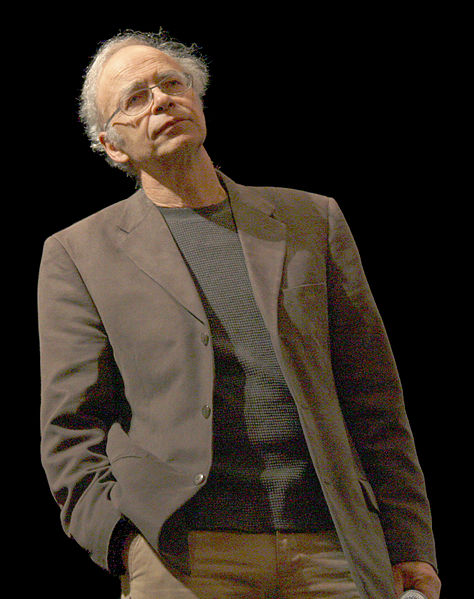
In light of this tragic anniversary, I want to go to an unusual source for thoughts on the question of when a new human life attains the right to life. Peter Singer is the Ira W. DeCamp Professor of Bioethics at Princeton University. His views on life, abortion, infanticide, and animal rights have shocked Americans for decades. However, Singer offers a stinging critique of traditional pro-choice arguments and an interesting aid to pro-life proponents.
Singer writes:
The central argument against abortion, put as a formal argument, would go something like this:
First premise: It is wrong to kill an innocent human being.
Second premise: A human fetus is an innocent human being.
Conclusion: Therefore it is wrong to kill a human fetus.
The usual liberal response is to deny the second premise of this argument. So it is on whether the fetus is a human being that the issue is joined, and the dispute about abortion is often taken to be a dispute about when a human life begins.
On this issue the conservative position is difficult to shake. The conservative points to the continuum between the fertilized egg and the child, and challenges the liberal to point to any stage in this gradual process that marks a morally significant dividing line. Unless there is such a line, the conservative says, we must either upgrade the status of the earliest embryo to that of the child, or downgrade the status of the child to that of the embryo; but no one wants to allow children to be dispatched on the request of their parents, and so the only tenable position is to grant the fetus the protection we now grant the child.
After considering various options for a morally significant dividing line, Singer concludes:
The liberal search for a morally crucial dividing line between the newborn baby and the fetus has failed to yield any event or stage of development that can bear the weight of separating those with a right to life from those who lack such a right, in a way that clearly shows fetuses to be in the latter category at the stage of development when most abortions take place. The conservative is on solid ground in insisting that the development from the embryo to the infant is a gradual process.
Unfortunately for those of us who agree with Singer on this particular point, he goes on to make the case that infanticide should be legal. He holds to the position that a child does not have the right to life until he has reached a stage of adequate self-awareness. He contemplates that such an adequate stage may not be reached until the age of two or three years old. However, for the sake of the overwhelming negative reaction he might get, he is willing to legalize infanticide up to about one month after birth. In my opinion, the outrageous conclusions of his own argument actually help to strengthen the pro-life argument even further because it becomes the only plausible position.
Despite the fact that Singer’s ultimate conclusion is just as horrendous as legalized abortion, his critique of the classic pro-choice argument is very helpful. As this debate continues in the public square, it might be useful for pro-lifers to take note of Singer’s critiques and employ them where appropriate.
_________________________
Peter Singer, “Taking Life: The Embryo and the Fetus,” (from Practical Ethics) in Writings on an Ethical Life (New York: HarperCollins, 2000), 146-64.
 The audio from today’s interview on Knowing the Truth radio program is available here.

 Ethics as Worship