Southwestern Baptist Theological Seminary launched a new blog several weeks ago. The blog is called Theological Matters, and the content is supplied by faculty and staff at the seminary. This week Theological Matters ran my post about Penn State and the Lost Idea of Personal Responsibility that ran here on Thursday. This new blog is a great resource for preaching, theology, church history, and ethics. I would encourage you to take a look at the articles on the new blog. I think you will enjoy them.
Tag: Theology
Church to Vote on Continuing Heterosexual Marriage Ceremonies
 A church in Raleigh, NC, is gearing up for a vote on November 20 to decide if it will stop holding “state-sanctioned marriages” on their property. According to an article in Raleigh’s News & Observer, the deacon council at Pullen Memorial Baptist Church drafted a marriage equality statement in response to pastor Nancy Petty’s conscientious objection to endorsing marriages involving a state license for heterosexual couples while the state forbids same-sex marriage. Brooks Wicker, the co-chair of the deacon council stated,
For us, it’s very much a civil rights issue. It’s in keeping with our tradition of trying to live into the gospel, treating everyone justly and fairly.
On Nov 20, the congregation will hold a vote to determine the future of marriage ceremonies at the church. While this may seem unusual, Pullen Memorial is no stranger to the unusual in Baptist life. The church began embracing the “social gospel” and ecumenism in the 1930’s. In 1950, Harry Emerson Fosdick delivered the dedication sermon for their new sanctuary. In 1992, the church endorsed “unqualified acceptance” of gay and lesbian members. This move ultimately led to their ouster from the Raleigh Baptist Association, Baptist State Convention of NC, and Southern Baptist Convention.
Now the church stands on the cusp of eliminating marriage ceremonies for the foreseeable future from their practice. Petty, a self-professed lesbian, told the congregation that endorsing state-sanctioned marriages for heterosexuals was a burden on her conscience, and the church responded by bringing it up for a vote.
The real question here is whether or not God gets a vote in this matter. Wicker noted that he believed it was in keeping with the church’s tradition of living “into the gospel,” but I believe he has the direction wrong. It appears that “living into the gospel” is a way of adding cultural biases to the gospel. He sees gay-marriage as a civil right that needs to be affirmed by the gospel and that our lives change the gospel. However, Scripture suggests that we need the gospel to live in us and allow it to change us. Rather than living into the gospel, I want the gospel to live in me.
So what should we make of this vote? I think it is fairly clear from their history and current trajectory that Pullen Memorial will vote to cease all marriages until same-sex marriage is legalized by the state of NC. The unfortunate part of the vote is that a church will most likely vote contrary to Scripture. From the institution of the first marriage in Genesis 2, God has made it clear that marriage is between a man and a woman. In Genesis 2:22–24, we read:
The Lord God fashioned into a woman the rib which He had taken from the man, and brought her to the man. The man said, “This is now bone of my bones, and flesh of my flesh; she shall be called Woman, because she was taken out of Man.” For this reason a man shall leave his father and his mother, and be joined to his wife; and they shall become one flesh.
Throughout the rest of Scripture, every reference to marriage is always between a man and a woman. In Leviticus 18:22 and 20:13, homosexual activity is clearly condemned (called an abomination), and that condemnation is repeated in Romans 1:24–32 and 1 Corinthians 6:9–11. Scripture makes it very clear that homosexual activity is against nature and against God’s intended design. Attempting to dignify it by placing the label of “marriage” on it simply flies in the face of what God intended for marriage as well.
So will God get a vote at Pullen Memorial? Let’s think about this—theology is not governed by democracy. Majority vote does not decide what truth is. God gets the only vote that matters, and he has already cast the deciding vote on this issue. Marriage is a covenant between one man and one woman. It is designed to last a lifetime. No church vote can change that. If Pullen Memorial wants to be on the side of God, they will change their stand on homosexual marriage. If they don’t, then they aren’t really attempting to be a church in submission to Christ and his Word. They might as well change their name to Pullen Memorial Social Club.
_________________________
Josh Shaffer, “Church puts civil marriage rites to vote,” News & Observer, November 11, 2011.
I would like to thank my friend, Randy Mann, for bringing this article to my attention. Check out his website at www.randymann.net.
Dug Down Deep Book Review
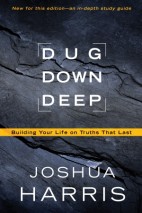 Dug Down Deep: Building Your Life on Truths That Last. By Joshua Harris. Colorado Springs: Multnomah, 2011. 271 pages. Softcover, $14.99.
Joshua Harris, the senior pastor of Covenant Life Church in Gaithersburg, MD, has re-released a slightly updated version of his 2010 book, Dug Down Deep. The 2011 version includes a study guide for personal or group study. Harris is the author of several other books, including I Kissed Dating Goodbye, Boy Meets Girl, Not Even a Hint, and Why Church Matters. In this volume, Harris explores some of the foundational truths of Christianity while interweaving his own story of life and growing in faith.
The book begins with Harris’ personal story of coming to faith and realizing that doctrine and orthodoxy matter. He notes, “The irony of my story—and I suppose it often works this way—is that the very things I needed, even longed for in my relationship with God, were wrapped up in the very things I was sure could do me no good. I didn’t understand that seemingly worn-out words as theology, doctrine, and orthodoxy were the pathway to the mysterious, awe-filled experience of truly knowing the living Jesus Christ” (16).
After telling about his own journey, Harris discusses the basic doctrines of the Christian faith in a systematic, yet easily readable, fashion. He covers topics such as the Bible, Christology, the Atonement, Redemption, Sanctification, Pneumatology, and the Church. However, he does so with creative titles (“God With a Bellybutton” for Christology and “Changed, Changing, To Be Changed” for Sanctification) and plenty of stories to keep the reader’s attention. While he certainly does not go to the depths and length of discussion that classic systematic theologians (e.g., Wayne Grudem, Millard Erickson) have in their books, Harris covers the basics and gives ample introductions to these doctrines. He also demonstrates the importance of these doctrines for the Christian life. It is obvious, and noted by one of the book’s endorsements, that Harris was aiming for something in the vein of J. I. Packer’s Knowing God. While this book will most likely never become an enduring classic like Packer’s, it does have the same readability and concern for doctrine that I found as a college student first reading Packer.
The weakness of the book stems from the intention of the project. Harris is light on some details of doctrine and heavy on personal stories, but this is the product of trying to reach the type of crowd that is uncertain of why they should study doctrine. This becomes extremely evident in his discussion of the Holy Spirit. After admitting to charismatic tendencies in his own theology, Harris states, “In case you’re feeling nervous about where I’m headed, let me assure you that I’m no longer interested in shocking people when it comes to discussing the Holy Spirit. In fact, I’m going to do my best to skirt the controversial issues associated with him” (176). For a surface discussion of theological ideas, this approach is probably fine; however, those interested in deeper discussions of theology will probably be a little disappointed.
The final chapter of the book is a much-needed admonition to all who discuss theology. The title of the chapter is “Humble Orthodoxy,” and Harris sets out to warn his readers from growing prideful in their new-found knowledge of doctrine. He writes, “Genuine orthodoxy—the heart of which is the death of God’s Son for undeserving sinners—is the most humbling, human-pride-smashing message in the world. And if we truly know the gospel of grace, it will create in us a heart of humility and grace toward others” (225). As a seminary professor who sees students go through various stages of pride and humility during their days in formal theological education (as I myself did), I wish everyone would take heed of the words in this chapter.
At the end of the day, Harris’ book is a worthwhile read. I approach some of these doctrines with slightly different interpretations (especially his discussion of the Holy Spirit), but the book serves as a good resource for why theology is important in everyday life, not just in the classroom.
It’s the End of the World as We Know It
 In 1987, the band R.E.M. released a song entitled, “It’s the End of the World as We Know It.” For those of us who were old enough to remember that song in the late ‘80’s (and subsequently released a few more times on “Best Of” and compilation albums), we get that catchy tune stuck in our heads and then finish the line, “and I feel fine…” (I apologize to all of you who now have the song permanently on repeat in your head). For some reason, that song has popped into my head any time I think of the claims of the doomsday “prophet” Harold Camping and his prophecy that the world will come to an end on May 21, 2011.
I had seen the billboards and read news articles about Camping’s prediction, but I decided to go to his website and read his argument for myself a couple of weeks ago. I think the logic of his argument may leave you speechless, but not in a good way. Let me summarize.
Camping claims that he can prove definitively that the flood (Genesis 6-9) occurred in 4990 B.C., although he does not offer that proof with his current claims. Then he uses 2 Peter 3:8 as a hermeneutical grid for the interpretation of God’s revelation and time. Peter writes, “But do not let this one fact escape your notice, beloved, that with the Lord one day is like a thousand years, and a thousand years like one day.” Based on a literal interpretation of that verse, Camping argues that God gave mankind 7,000 years to repent before the judgment based on the statement in Gen 7:4 that God told Noah the flood would start 7 days after he gathered the animals to the ark. Since Camping believes 7 days equals 7,000 years, we get to 2011.
Next, he believes that the exact date of the crucifixion of Jesus was April 1, 33 A.D. He has calculated that there are 722,500 days between April 1, 33 and May 21, 2011 taking into account leap years, etc. Camping believes this is a significant number because you can multiply 5x10x17x5x10x17 to get 722,500. According to his numerology, 5 is the number of atonement or redemption, 10 is the number of completeness, and 17 is the number of heaven. Since these numbers ought to be doubled, or repeated, for significance (based on 2 Peter 3:8), then the multiplication sequence brings us to the number of days until the rapture.
Here is Camping’s conclusion to his argument:
We must comment further about the incredible nature of this proof which is completely based on Biblical information.
1. April 1, 33 A.D. is the date God focuses our attention on, how Christ died to atone for our sins as Christ was crucified on that day. The number 5 also focuses on that day, inasmuch as it can spiritually signify the atonement.
2. Our salvation is entirely completed at the time believers receive their eternally alive resurrected bodies. This is what happens on the day of the Rapture, May 21, 2011. Thus the period of April 1, 33 A.D. to May 21, 2011 (inclusive) is the complete period from the time God shows us how our salvation was accomplished to the time our salvation has been entirely completed. This coincides perfectly with the number 10, which signifies completeness.
3. On May 21, 2011, the date of the Rapture, each and every saved person goes to Heaven because his salvation is altogether completed. The number 17 fits perfectly because it signifies Heaven when it has spiritual meaning.
4. The doubling of the numbers 5 x 10 x 17 like the doubling of the phrase “a day is as a thousand years” assures us that the truth of these proofs is established by God and will shortly come to pass. Isn’t it amazing that God uses this doubling principle to further guarantee that the date May 21, 2011 is absolutely certain, even as God has used it to absolutely assure us that Judgment Day is exactly 7,000 years after the flood of Noah’s day.
Indeed, in the face of all of this incredible information, how can anyone dare to dispute with the Bible concerning the absolute truth that the beginning of the Day of Judgment together with the Rapture will occur on May 21, 2011.
Thus, Camping and his followers reach the conclusion that May 21, 2011 is “the end of the world as we know it” (my apologies to R.E.M.). Of course similar predictions have been made before by Camping and others. Camping made similar predictions for 1988 (he claims on his website that the church age ended on May 21, 1988) and 1994. Similar predictions by other groups include the infamous prediction by William Miller that the rapture would occur on March 21, 1844. This failed prediction led to the founding of the Adventist Church.
What are we to make of all this? I want to offer two thoughts. First, Scripture makes it clear that anything stated by a true prophet of God will indeed come true. If it does not come to pass, then we are not to fear (or respect) such a prophet. In Deuteronomy 18:22, we read, “When a prophet speaks in the name of the Lord, if the thing does not come about or come true, that is the thing which the Lord has not spoken. The prophet has spoken it presumptuously; you shall not be afraid of him.” We have seen these predictions before from Harold Camping and others. They claim to speak for the Lord with incontrovertible proof that God has revealed to them his plans. They have all been wrong about the end of the world. Camping lost credibility when his previous predictions failed, and Scripture clearly states that we are not to fear him. In fact, other so-called prophets in Scripture subsequently received the moniker “false prophet.” I believe the same holds true here.
Second, Jesus made it perfectly clear that no one knows the day or time of his return. In Matthew 24:36, Jesus says, “But of that day and hour no one knows, not even the angels of heaven, not the Son, but the Father alone.” Earlier in that same discussion with his disciples, Jesus warns them against false prophets who will attempt to lead them astray (Matthew 24:4-5, 11, 23-26). Harold Camping claims to know what Jesus himself claims not to know. This is dangerous territory—territory that I will avoid at all costs.
What should we do then? I believe we should heed the words of Jesus in Matthew 24:14 when he says, “This gospel of the kingdom shall be preached in the whole world as a testimony to all the nations, and then the end will come.” Let’s proclaim the gospel message to the ends of the earth, not for the purpose of ushering in the end of the world, but because we have been commissioned to do so (Matthew 28:19-20).
If God wills, I plan to teach my class at church on May 22. We’ll be starting a new series on the life of Christ. We do not know what our lives will be like tomorrow for we are just a vapor (James 4:14-15). However, we do not fear the prophets who claim to speak for God yet do not exhibit the biblical evidence of being prophets. If the end of the world comes tomorrow, it has nothing to do with Camping’s “prophecy.” My guess is that we will be exercising this speculation again as we approach December 21, 2012—the supposed end of the Mayan calendar.
On the Death of a Terrorist
On the evening of May 1, 2011, the President of the United States announced the death of one of the world’s most infamous terrorists, Osama bin Laden. Almost immediately after President Obama’s official announcement, spontaneous celebrations broke out in front of the White House, at Ground Zero, and around the country. News of such celebrations left me a little hollow. I certainly want to rejoice that the face of terrorism is no longer able to devise wicked schemes for destroying other lives, but I am also saddened by the fact that a soul now has found his eternal destiny separated from God.
On the news this morning, I watched an interview with the mother of one of the victims on United Airlines Flight 93 that crashed in Pennsylvania after passengers rushed the cockpit. She had a balanced view concerning Bin Laden’s death. She said it was a bittersweet moment because justice had been served but it also served as a reminder of the tragedies of that day nearly ten years ago.
Twitter also lit up with news and reaction about Bin Laden’s death. Most of the tweets related joy, happiness, and satisfaction in the terrorist’s death. Some noted congratulatory sentiments to Presidents Obama and Bush. Others cheered the efforts of the Navy SEALS who carried out the plan to attack Bin Laden’s compound.
Finally, the crowd at the nationally-televised baseball game between the New York Mets and the Philadelphia Phillies began chants of “U-S-A, U-S-A, U-S-A” as the news of the announcement spread via social media, text messages, and emails.
So, what is the proper biblical reaction to the death of a terrorist? How should we feel? Should we join the crowds and rejoice in the streets? Should we cry over a soul eternally condemned to hell? Should we feel justified in a country that diligently pursued a perpetrator and administered justice? I want to provide three thoughts for consideration as we reflect upon the death of a terrorist.
First, we can know that justice was administered by a properly established authority. There is no doubt that President George W. Bush struggled with the decision to wage a “War on Terror” after the devastation of September 11, 2001. Just as Presidents before him had carried the burden of placing the lives of their military in harm’s way to enact justice, President Bush had to bear such a burden. No one probably thought that such a war would continue for ten years before the mastermind of the attacks was captured or killed, but that is what happened. In my recent readings on just war theory, I was reminded of one of the first principles of jus ad bellum (just principles for going to war). The principle of legitimate authority requires that war be waged only by those that have the legitimate authority to do so. Historically, this has been interpreted to mean sovereign governments over nation states. Thus, the United States of America in her sovereign authority waged war in order to administer justice for evils perpetrated against her people.
In Romans 13:1-4. Paul describes the role of the government in administering justice. He writes:
Every person is to be in subjection to the governing authorities. For there is no authority except from God, and those which exist are established by God. Therefore whoever resists authority has opposed the ordinance of God; and they who have opposed will receive condemnation upon themselves. For rulers are not a cause of fear for good behavior, but for evil. Do you want to have no fear of authority? Do what is good and you will have praise from the same; for it is a minister of God to you for good. But if you do what is evil, be afraid; for it does not bear the sword for nothing; for it is a minister of God, an avenger who brings wrath on the one who practices evil.
Note the final line of the quotation (v. 4). The governing authority “is a minister of God, an avenger who brings wrath on the one who practices evil.” From a biblical standpoint, we can rest assured that the American government has fulfilled its God-given duty in bringing wrath on one who practices evil.
Second, we can lament that a life has been taken. But you may protest, “Bin Laden was responsible for the deaths of thousands, why should we lament the death of such a wicked man?” We lament because that is what God does. In Ezekiel 33:11, God tells Ezekiel, “‘As I live!’ declares the Lord GOD, ‘I take no pleasure in the death of the wicked, but rather that the wicked turn from his way and live. Turn back, turn back from your evil ways!’” God does not rejoice when life is taken, especially when those who have no concern for the truth of God are killed. Even when we see God taking the lives of those who have turned from him (e.g., Nadab and Abihu in Lev 10:1-7), we do not see rejoicing from God. It is solemn and terrifying that life is squelched for the sake of justice.
The more disheartening thing about it is the warranted assumption that Bin Laden’s eternal destiny in hell has been sealed. Of course, we do not know his heart nor the possibility of a last minute conversion to faith in Christ; however, it seems safe to assume that Bin Laden never placed his faith in Christ as his personal Savior. His actions did not give evidence of a life that has been surrendered to God. In 1 John, the apostle gives us a few thoughts concerning our actions that give evidence to our spiritual lives. In 1 John 1:6, we see, “If we say that we have fellowship with Him and yet walk in the darkness, we lie and do not practice the truth.” In 1 John 2:11, the apostle tells us, “But the one who hates his brother is in the darkness, and does not know where he is going because the darkness has blinded his eyes.” Finally, in 1 John 5:12, we read, “He who has the Son has the life; he who does not have the Son of God does not have the life.” Based on Bin Laden’s actions and his murderous background, we have warrant to assume that his life was characterized by darkness rather than the light of a relationship with Christ. Thus, his eternal destiny would be separation from God in hell.
Finally, we should use this occasion as an opportunity to remember that sin has a drastic impact on our world. From the days of Genesis 3 onward, we have battled the effects of sin on a personal and global level. It is easy to point a finger at Bin Laden and say, “He was evil!” It is much harder to point a finger at ourselves and say, “I am evil!” However, that is exactly what the Bible tells us about ourselves. In Romans 3:9-12, we read:
What then? Are we better than they? Not at all; for we have already charged that both Jews and Greeks are all under sin; as it is written, ‘There is none righteous, not even one; there is none who understands, there is none who seeks for God; all have turned aside, together they have become useless; there is none who does good, there is not even one.’
Thankfully, that is not the end of the story. Christ sacrificed his own life for us and paid the penalty for our sin. As we see later in Romans 10:9-13, Paul states:
If you confess with your mouth Jesus as Lord, and believe in your heart that God raised Him from the dead, you will be saved; for with the heart a person believes, resulting in righteousness, and with the mouth he confesses, resulting in salvation. For the Scripture says, ‘Whoever believes in him will not be disappointed.’ For there is no distinction between Jew and Greek; for the same Lord is Lord of all, abounding in riches for all who call on Him; for ‘Whoever will call on the name of the lord will be saved.’
Though sin has brought evil and death to us and our world, Christ has overcome evil through his death, burial, and resurrection. May the people of the world see the death of a terrorist and be reminded of their own impending deaths. As a result, I pray that they would turn to Christ with childlike faith and trust in him for their eternal destiny.
 Ethics as Worship